
Set & card guides
MTG Star Trek: Collector and Product Guide
An early MTG Star Trek set guide to TRK, TRC, and SDS legality, confirmed products, release dates, card treatments, signed Headliners, and what to buy.
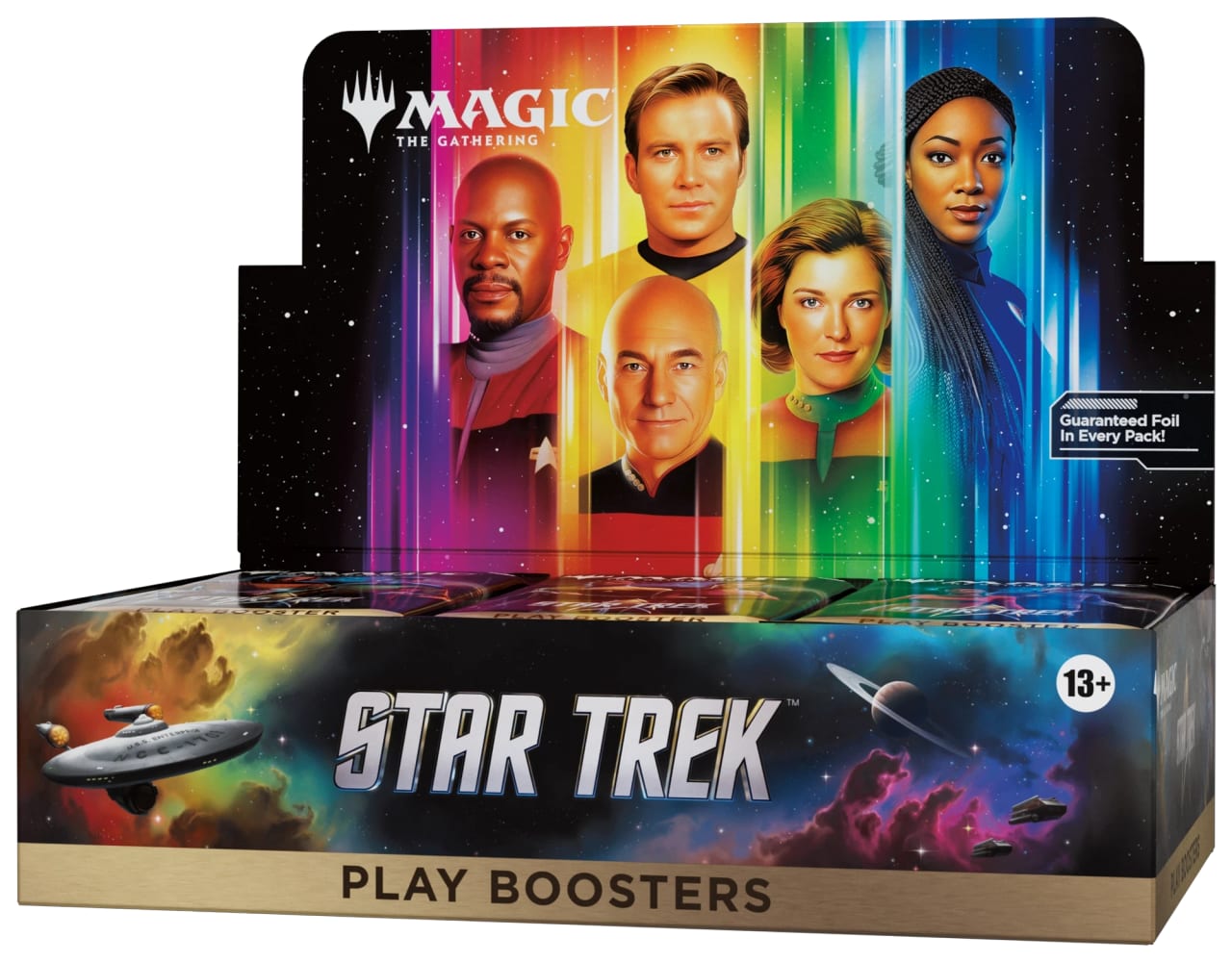
Magic: The Gathering | Star Trek is a full booster release with a separate Commander line, not a Commander-only crossover. It draws from 60 years of Star Trek and is scheduled for global tabletop release (opens in a new tab) on November 13, 2026. Play Boosters support Draft and Sealed, four preconstructed decks provide ready-to-play Commander paths, and Collector Boosters hold the premium-only finishes and hand-signed Headliner cards.
The useful way to read the product line is through its three set codes. The same official first-look guide identifies TRK as the main set, TRC as the Commander card pool, and SDS as 30 Stardates reprints. Those codes determine more than binder order: they separate Standard cards from eternal-format Commander designs and reprints whose legality follows the underlying card.
This is an early guide to what Wizards has confirmed. The product lineup, contents, MSRPs, major treatment families, release calendar, and four Commander themes are public. Complete decklists, the full card gallery, and several collector details are still to come.
TRK, TRC, and SDS are three different card pools
Set codes are compact identifiers, not a complete legality ruling. Our guide to MTG set symbols, set codes, and collector numbers explains how to find them on a printed card. For Star Trek, the code map is especially important:
- TRK is Magic: The Gathering | Star Trek, the main booster set. Wizards identifies it as legal in all formats, which makes it the route into Standard, Pioneer, Modern, Commander, Legacy, and Vintage, subject to the rules and banned list of each format.
- TRC is Magic: The Gathering | Star Trek Commander. Its new cards are legal in Commander, Legacy, and Vintage. A TRC reprint can also be played in another format that already permits the same card.
- SDS is the Stardates collection of 30 existing Magic cards with Star Trek artwork. These printings are legal in Commander, Legacy, and Vintage, plus any other format where the underlying card is already legal.
That last distinction prevents a common booster-pool mistake. TRK Play Boosters can contain SDS cards, and an SDS card opened from one of those packs is legal in that Star Trek Draft or Sealed pool. Opening it beside Standard-legal TRK cards does not by itself make the SDS printing Standard legal; the underlying card still must be legal there. Check the individual card against Wizards’ current Banned and Restricted list (opens in a new tab) before a sanctioned event.
The three-code structure resembles FINAL FANTASY’s FIN, FIC, and FCA product map, but the details are not interchangeable. In Star Trek, the reprint lane is SDS, the Commander lane is TRC, and the main all-formats set is TRK.
The important Star Trek release dates
The official release calendar (opens in a new tab) gives players these main dates:
- November 6-12, 2026: Prerelease events
- November 10, 2026: MTG Arena release
- November 13, 2026: Global tabletop release and the start of Magic Presents: To Boldly Go
- November 20-26, 2026: Commander Party, round one
- December 11-17, 2026: Commander Party, round two
- January 28, 2027: Magic Presents: To Boldly Go ends
Prerelease is the first scheduled tabletop window for Sealed play, while Arena arrives three days before the global tabletop release. Commander players have two later event windows rather than one launch-weekend deadline.
MTG Star Trek products and what each one does
The official Star Trek product page (opens in a new tab) divides the line into ordinary play products and premium collecting products, while Wizards’ first-look product details (opens in a new tab) give the exact contents confirmed so far. The names overlap, but their jobs do not.
Play Boosters support Draft, Sealed, and TRK collecting
A Play Booster contains 14 Magic cards plus a nonfoil double-sided token. Its 14 cards include seven commons, three uncommons, one wildcard of any rarity, one traditional foil of any rarity, one rare or mythic rare, and one land. In one out of every 25 Play Boosters, an SDS Stardates card replaces a common. A display holds 30 packs.
Choose Play Boosters for a Star Trek Draft, a Sealed pool, or a randomized route through the main TRK set. They are not the direct route to one named character, and they are not where the Collector Booster-only Surge Foils or signed Headliners appear. Our guide to MTG booster types explains why a Play Booster and a Collector Booster should not be treated as premium and budget versions of the same job.
Collector Boosters concentrate finishes and rare collectibles
A Collector Booster contains 15 Magic cards plus an art card or traditional foil double-sided token. The pack includes five traditional foil commons, three traditional foil uncommons, one foil common or uncommon, one traditional foil basic land, one traditional foil rare or mythic rare, one nonfoil extended-art rare or mythic rare, two rare or mythic rare Booster Fun cards, and one foil rare or mythic rare Booster Fun card. A display holds 12 packs.
Choose this product for the treatment hunt: Surge Foil LCARS and Classic Enterprise cards, traditional foil Stardates cards, premium Booster Fun slots, Klingon Script cards, and the chance at a signed Headliner. It is not designed for Draft or the most predictable way to obtain an ordinary playset.
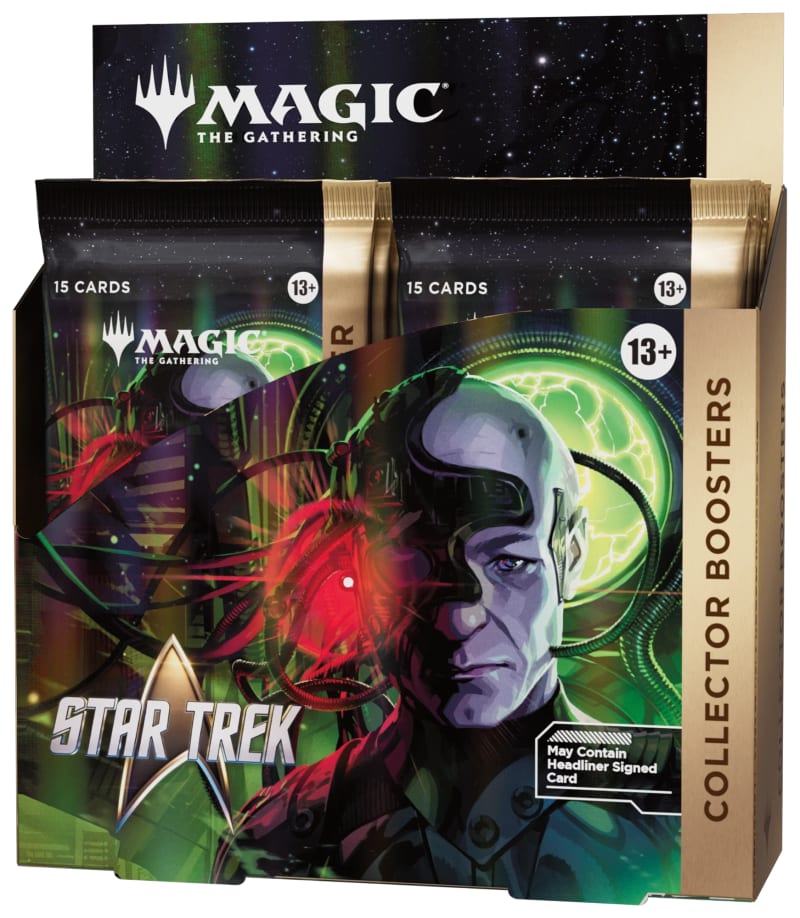
Star Trek Collector Booster Box
Collector Boosters are the treatment-focused route; they are not the Draft product.
Four Commander decks provide complete TRC strategies
Each standard Commander product contains a ready-to-play 100-card deck, with one traditional foil borderless face commander and 99 nonfoil cards. Of those 99 cards, 32 are new to Magic. The box also contains ten nonfoil double-sided tokens, a reference card, and a deck box.
The four confirmed decks have distinct themes:
- Federation Fleet is led by Jean-Luc Picard and uses seek out abilities to strengthen its crew and charge its starships.
- Landing Party is led by Commander Spock and uses landfall to reward discovering new worlds.
- Klingon Fury is led by Worf and rewards attacking multiple opponents in the same combat.
- We Are the Borg is led by the Borg Queen, creates Borg tokens, and assimilates opposing creatures.
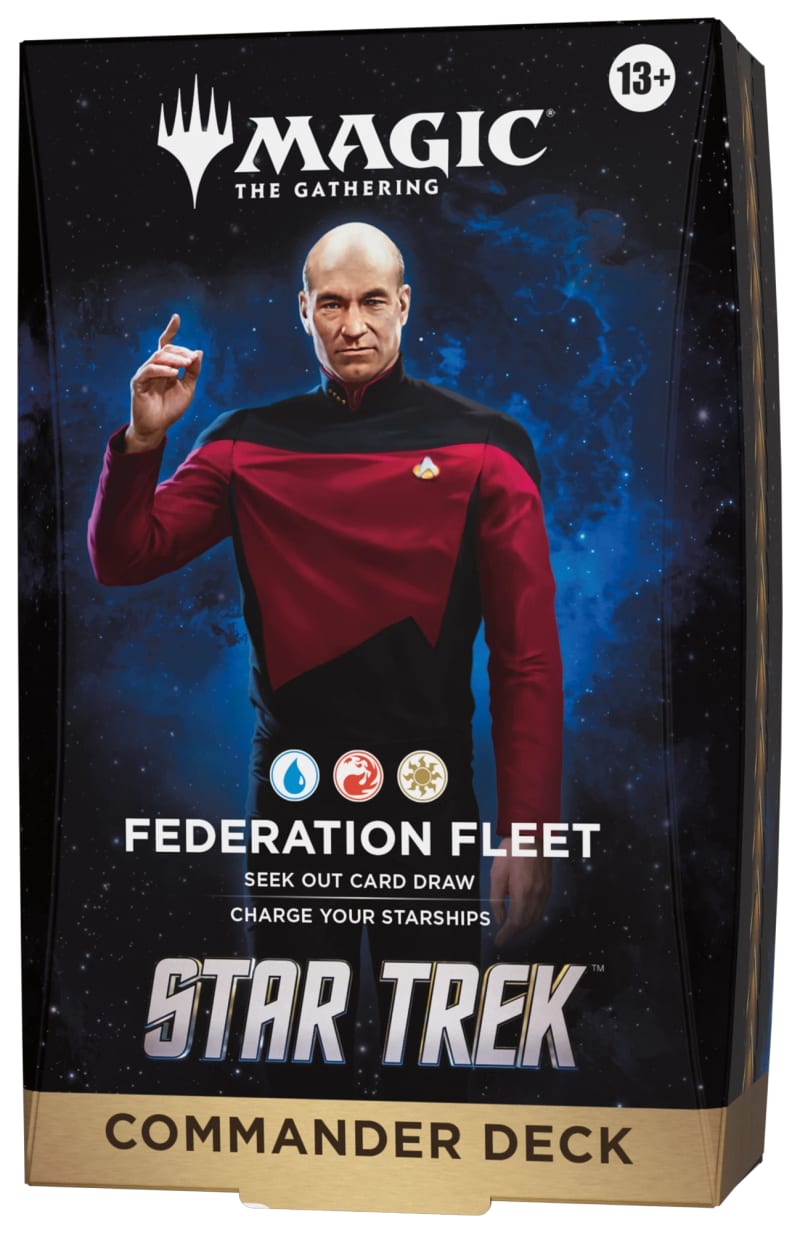
Federation Fleet Commander DeckOfficial product image via Wizards of the Coast (opens in a new tab) 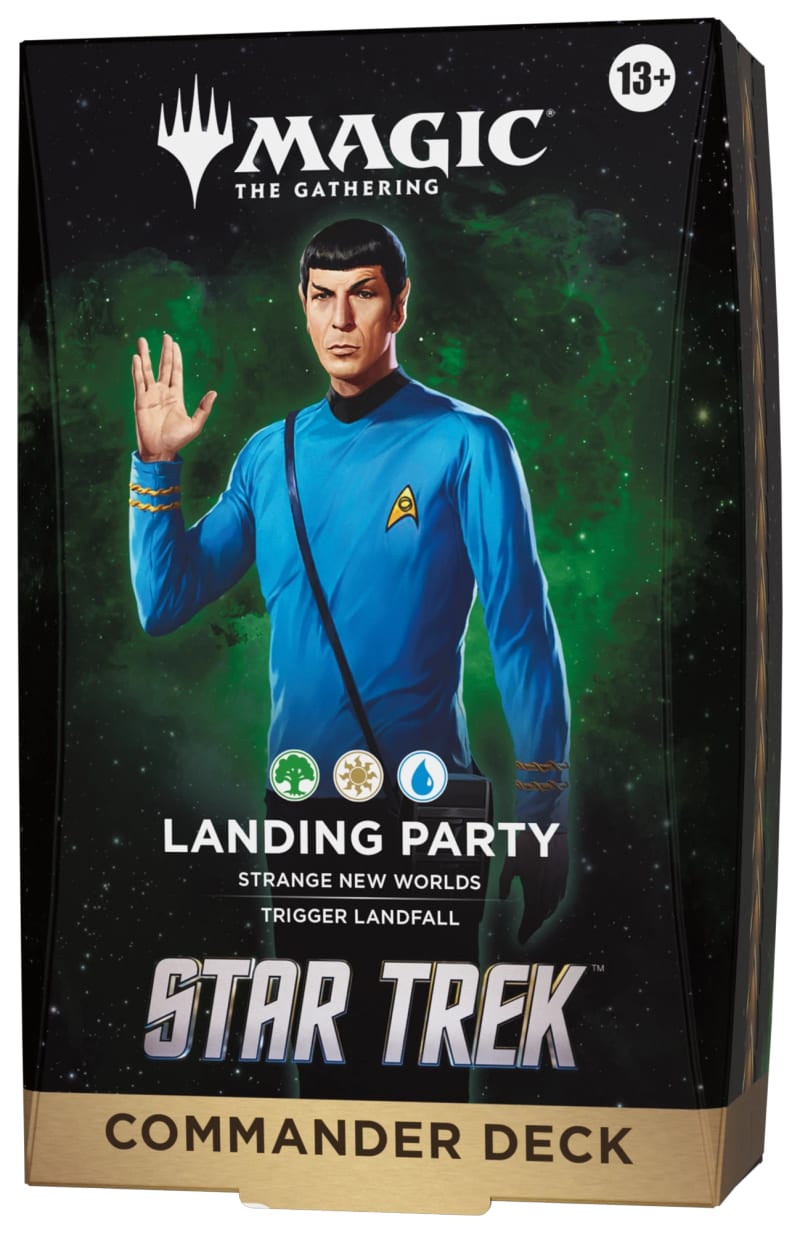
Landing Party Commander DeckOfficial product image via Wizards of the Coast (opens in a new tab) 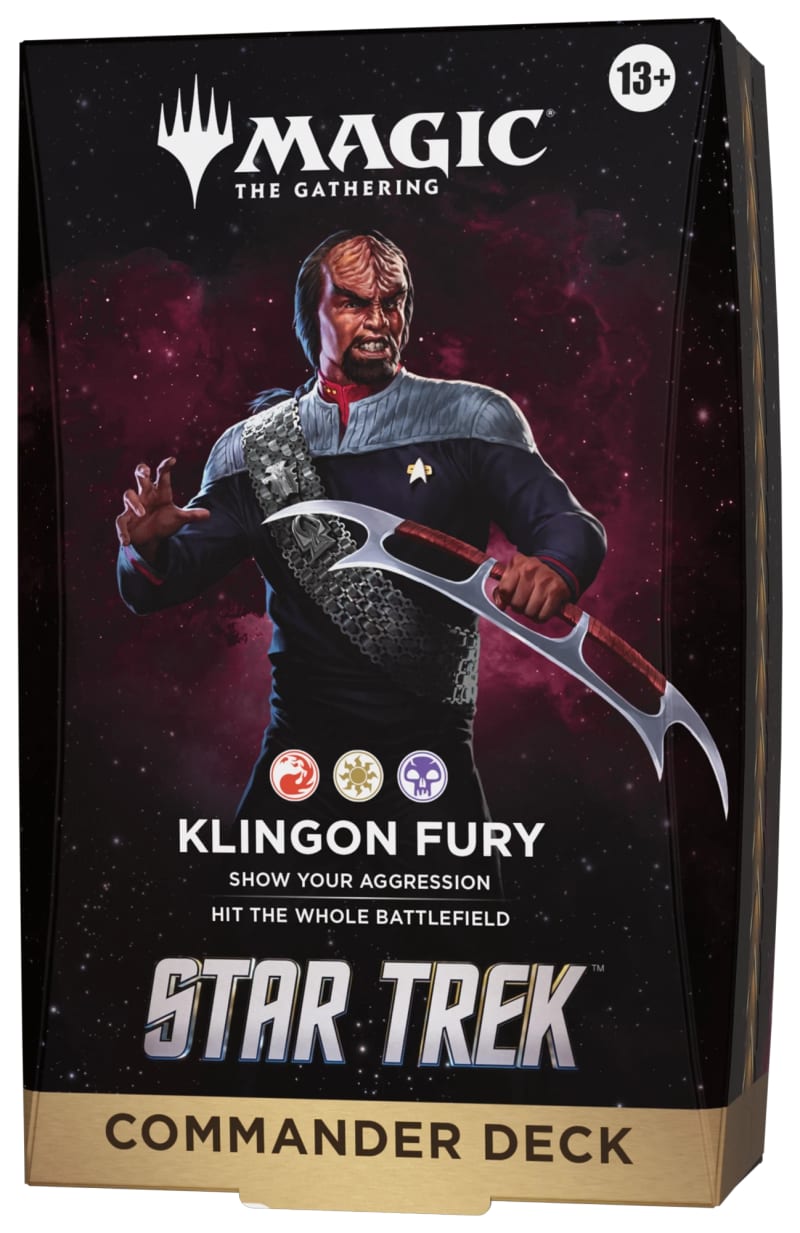
Klingon Fury Commander DeckOfficial product image via Wizards of the Coast (opens in a new tab) 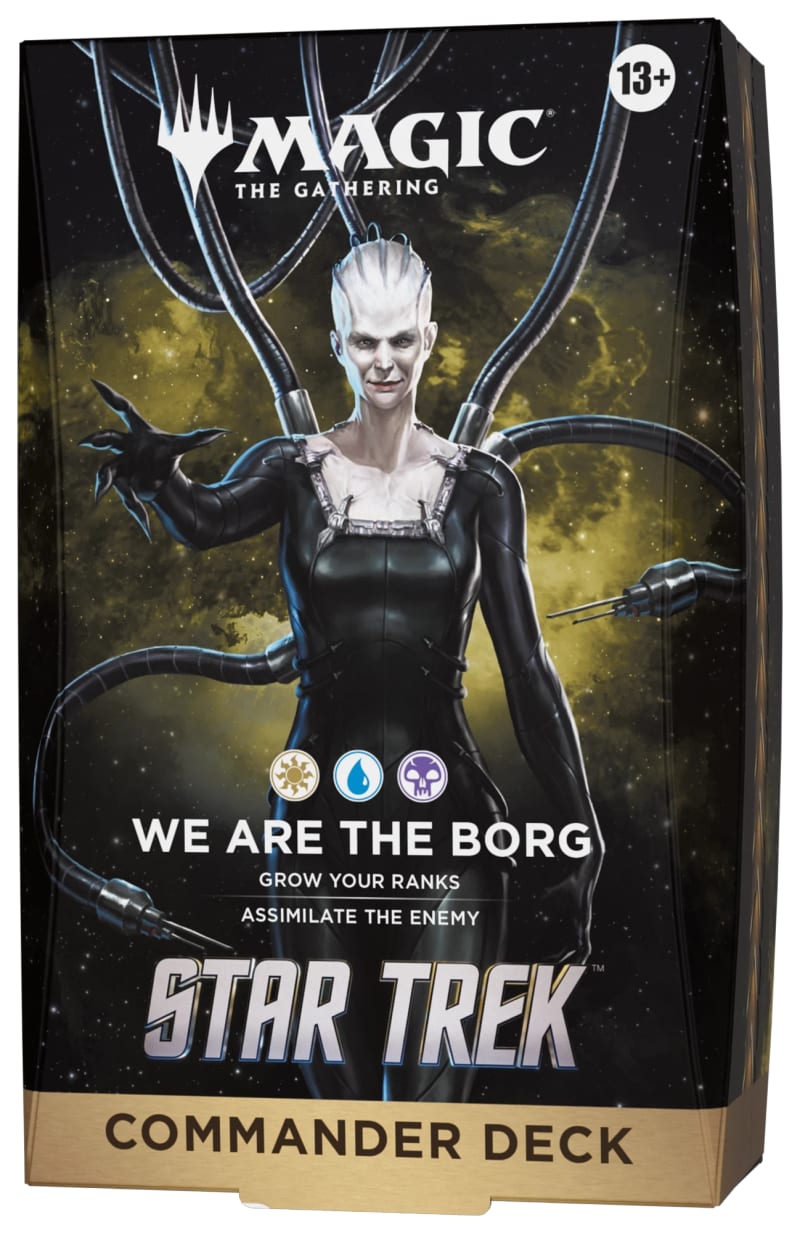
We Are the Borg Commander DeckOfficial product image via Wizards of the Coast (opens in a new tab)
The Collector’s Edition counterparts also contain a 100-card deck with 32 new-to-Magic cards, but the face commander and other 99 cards are all Surge Foil. Their ten double-sided tokens have Surge Foil on one side and no foil on the other. Choose a standard deck for a table-ready faction strategy. Choose its Collector’s Edition counterpart when the consistent all-Surge-Foil presentation is the goal.
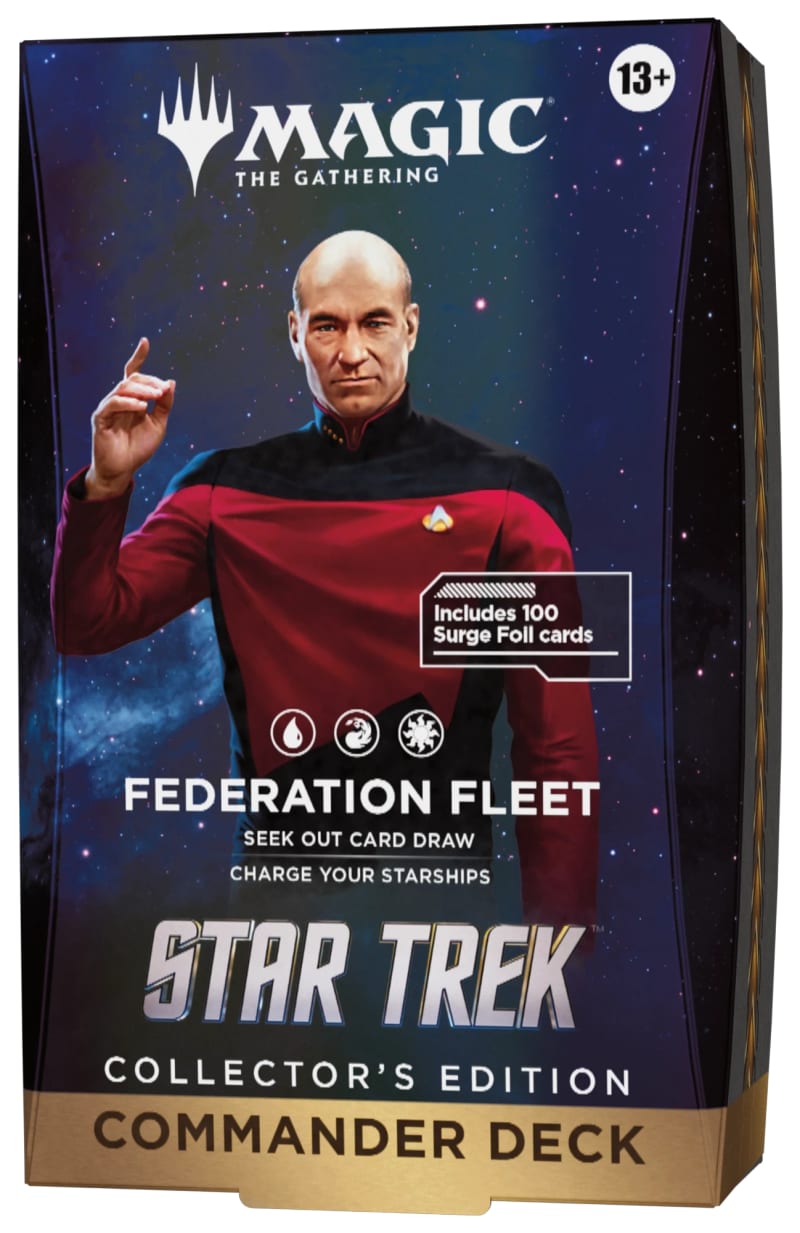
Federation Fleet Collector's Edition Commander DeckOfficial product image via Wizards of the Coast (opens in a new tab) 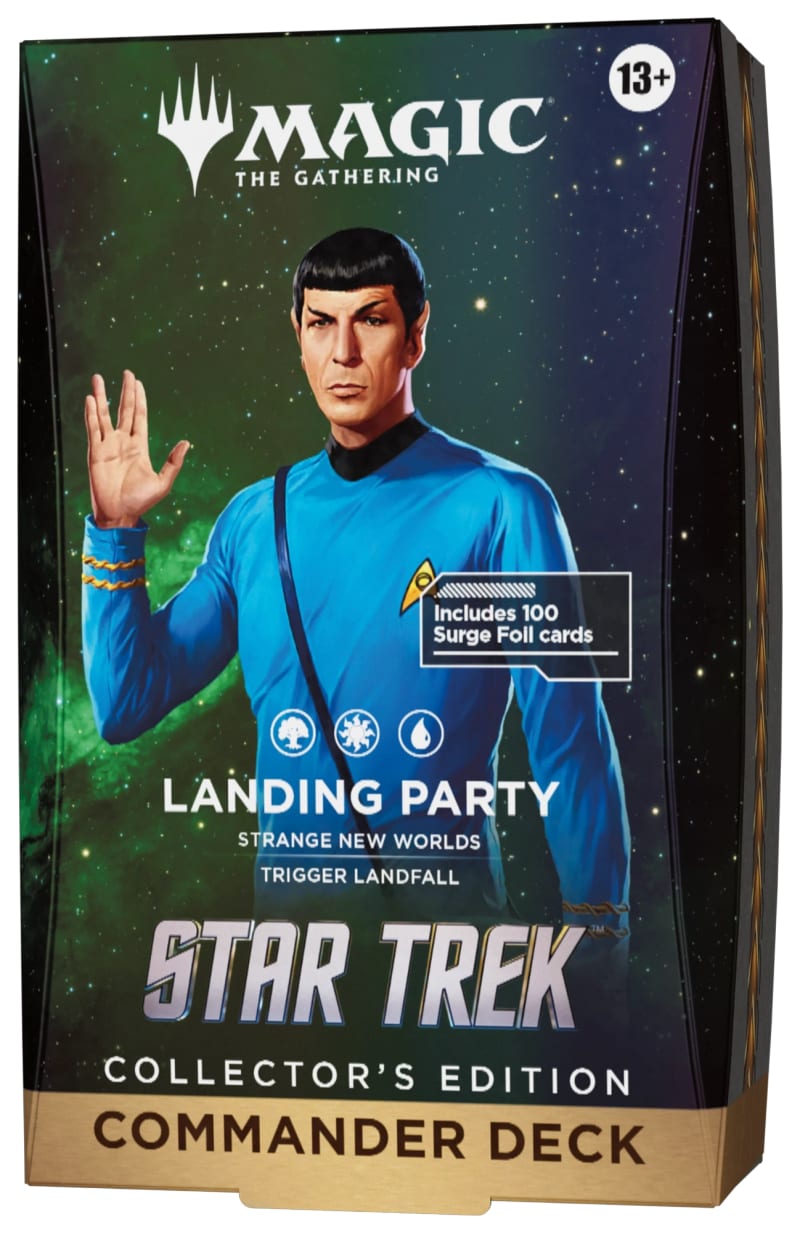
Landing Party Collector's Edition Commander DeckOfficial product image via Wizards of the Coast (opens in a new tab) 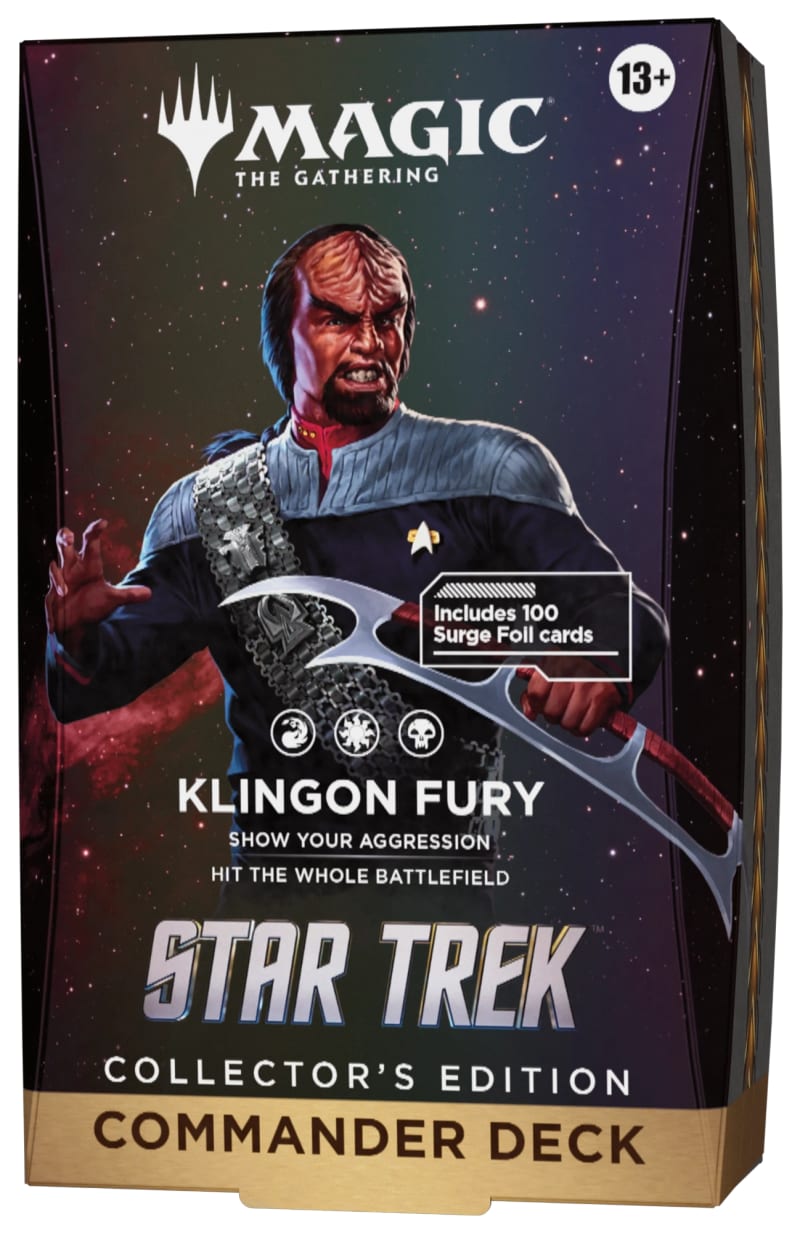
Klingon Fury Collector's Edition Commander DeckOfficial product image via Wizards of the Coast (opens in a new tab) 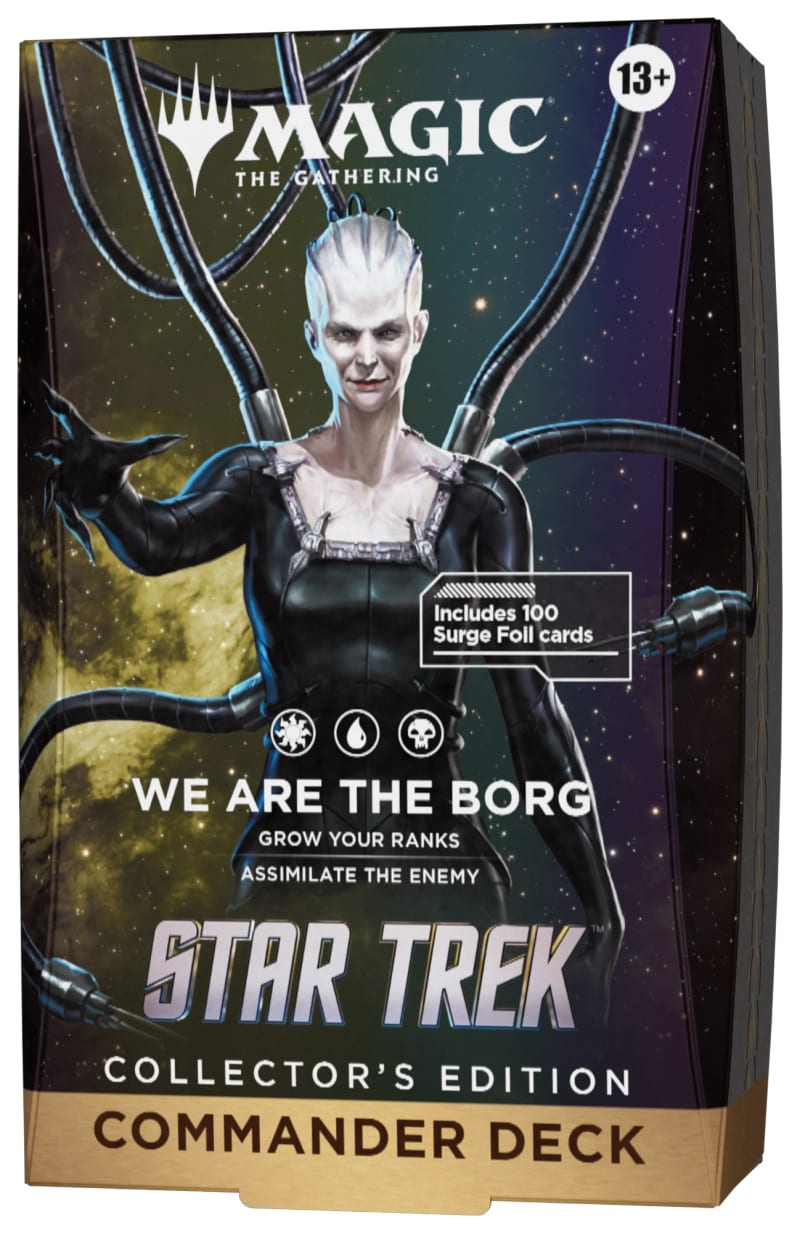
We Are the Borg Collector's Edition Commander DeckOfficial product image via Wizards of the Coast (opens in a new tab)
That is a broader release shape than the Commander-first Doctor Who collector line. Star Trek supports both Limited play through TRK Play Boosters and complete Commander play through TRC decks.
Bundles split into a general version and a ship-focused version
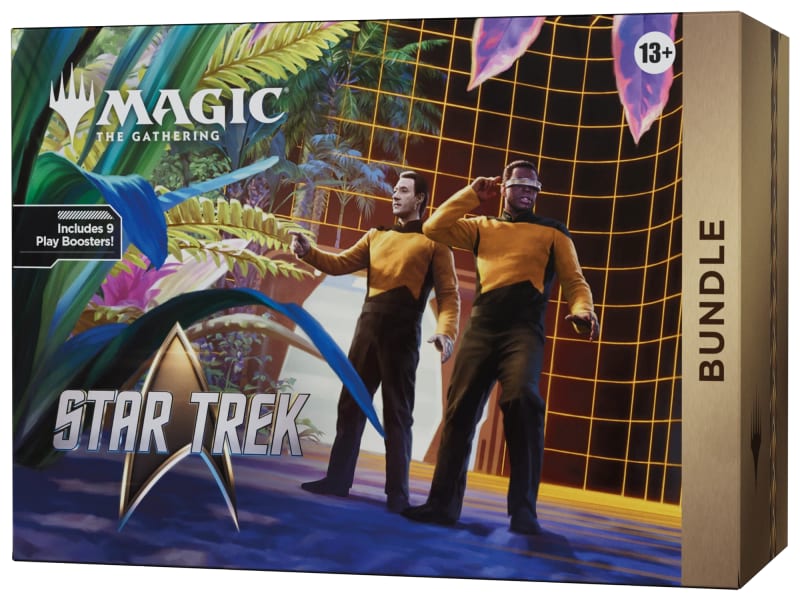
The standard Bundle contains nine Play Boosters, 15 traditional foil basic lands, 15 nonfoil basic lands, one traditional foil promo, two reference cards, an oversized spindown, and a storage box. Five lands in each finish are full art. This is the general gift or set-sampling bundle.
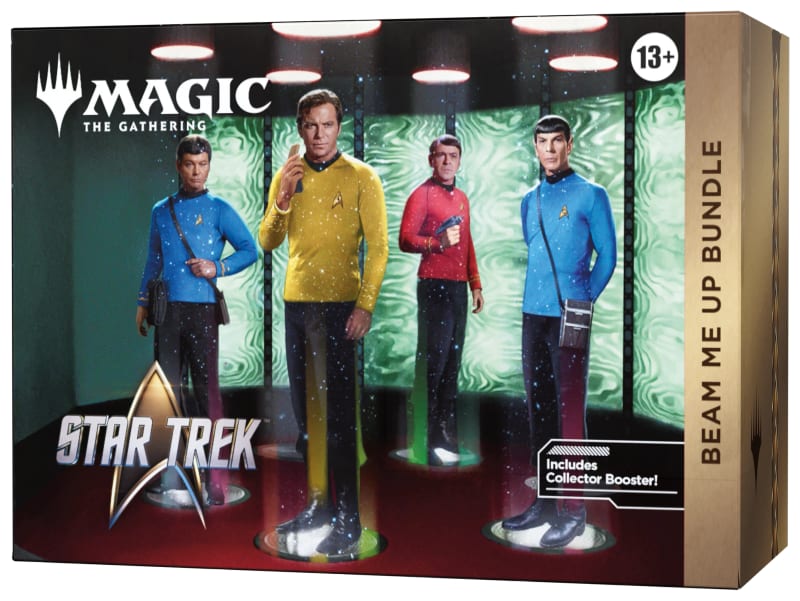
The Beam Me Up Bundle contains eight Play Boosters, one Collector Booster, the same 15 foil and 15 nonfoil basic-land counts, two traditional foil ship-schematic promos, two reference cards, an oversized spindown, and a storage box. Wizards has confirmed eight different schematic Spacecraft promos, with two in each Beam Me Up Bundle. The product page also identifies its full-art lands as Away Team lands. This is the more focused gift for someone who wants spacecraft art and one premium pack without moving to a Collector Booster display.
Beginner Box, Draft Night, and Prerelease Pack solve play-event jobs
The Beginner Box contains ten themed 20-card Jumpstart half-decks. Two are a matched tutorial pair; afterward, players can shuffle any two half-decks together to make a 40-card deck. Two gameboard playmats, two how-to-play guides, two reference cards, two spindown dice, five tokens, and a reference booklet make it the clearest retail choice for two Star Trek fans learning Magic together.
The Draft Night box contains 12 Play Boosters, one Collector Booster, 90 basic lands, ten double-sided tokens, and a draft insert. It is built for a four-player draft, with the Collector Booster positioned as a prize. The Prerelease Pack instead contains six Play Boosters, one traditional foil rare or mythic rare, a deck box, and a spindown for one player’s prerelease Sealed pool.
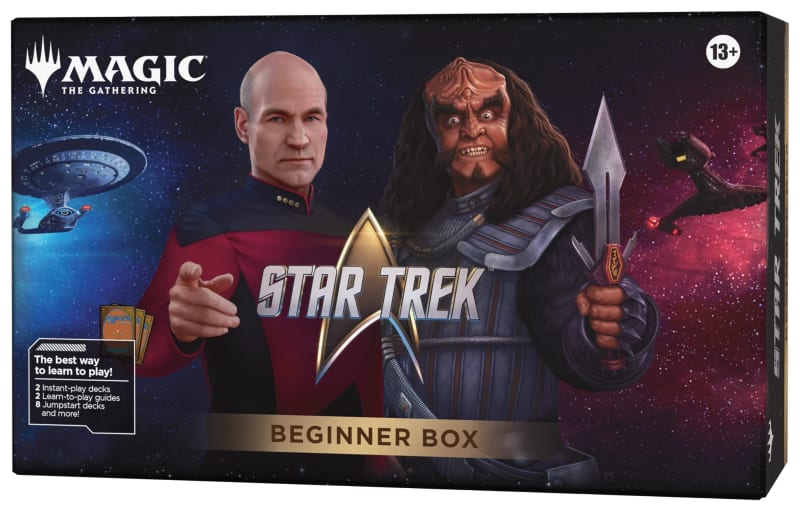
Star Trek Beginner BoxOfficial product image via Wizards of the Coast (opens in a new tab) 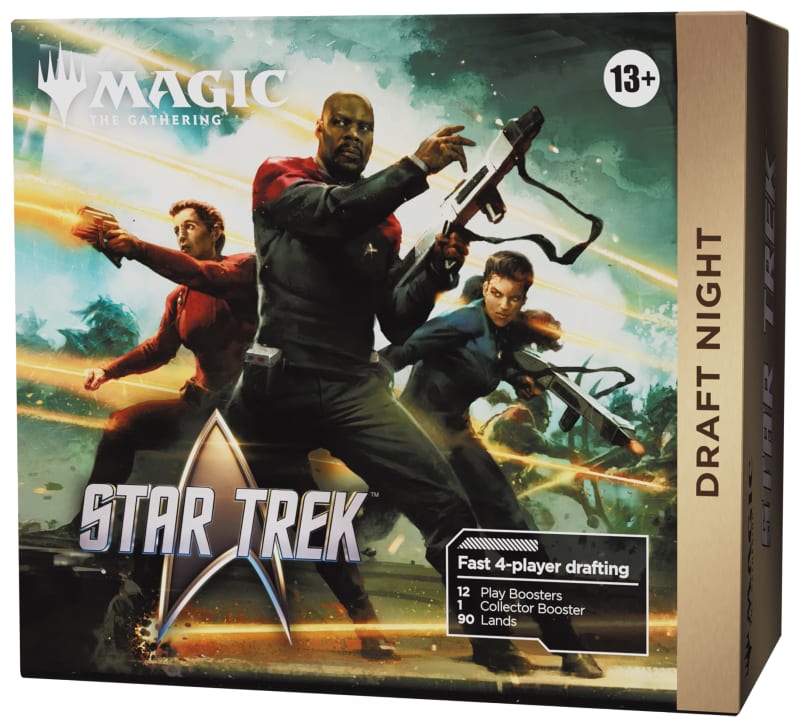
Star Trek Draft NightOfficial product image via Wizards of the Coast (opens in a new tab) 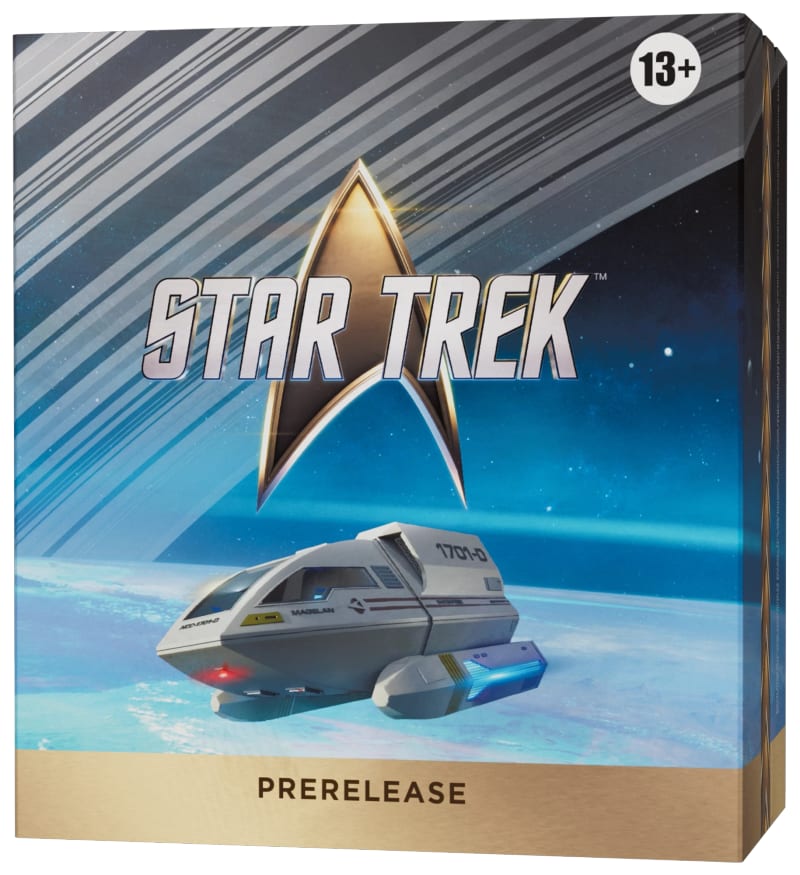
Star Trek Prerelease PackOfficial product image via Wizards of the Coast (opens in a new tab)
Wizards has also announced five monocolor 40-card Welcome Decks containing TRK and TRC cards. The official Welcome Deck announcement (opens in a new tab) describes them as teaching tools distributed through participating Wizards Play Network stores, not another MSRP retail box. Ask a participating store about availability.
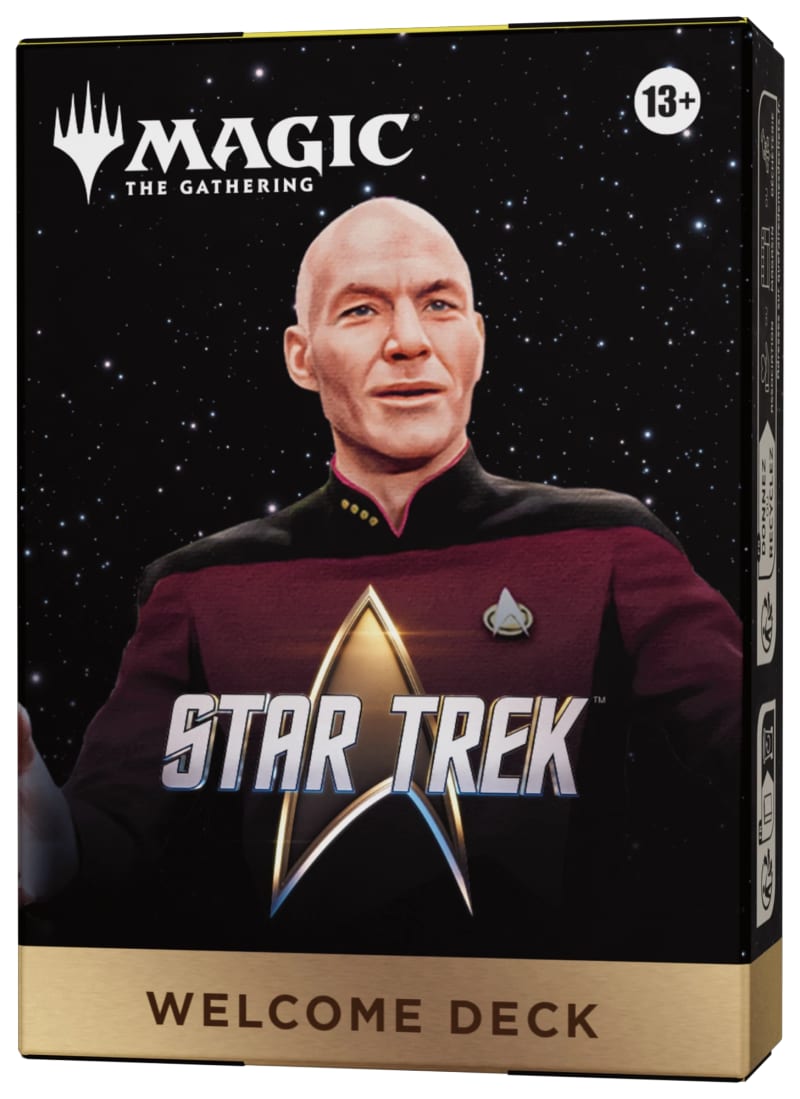
White Star Trek Welcome DeckOfficial product image via Wizards of the Coast (opens in a new tab) 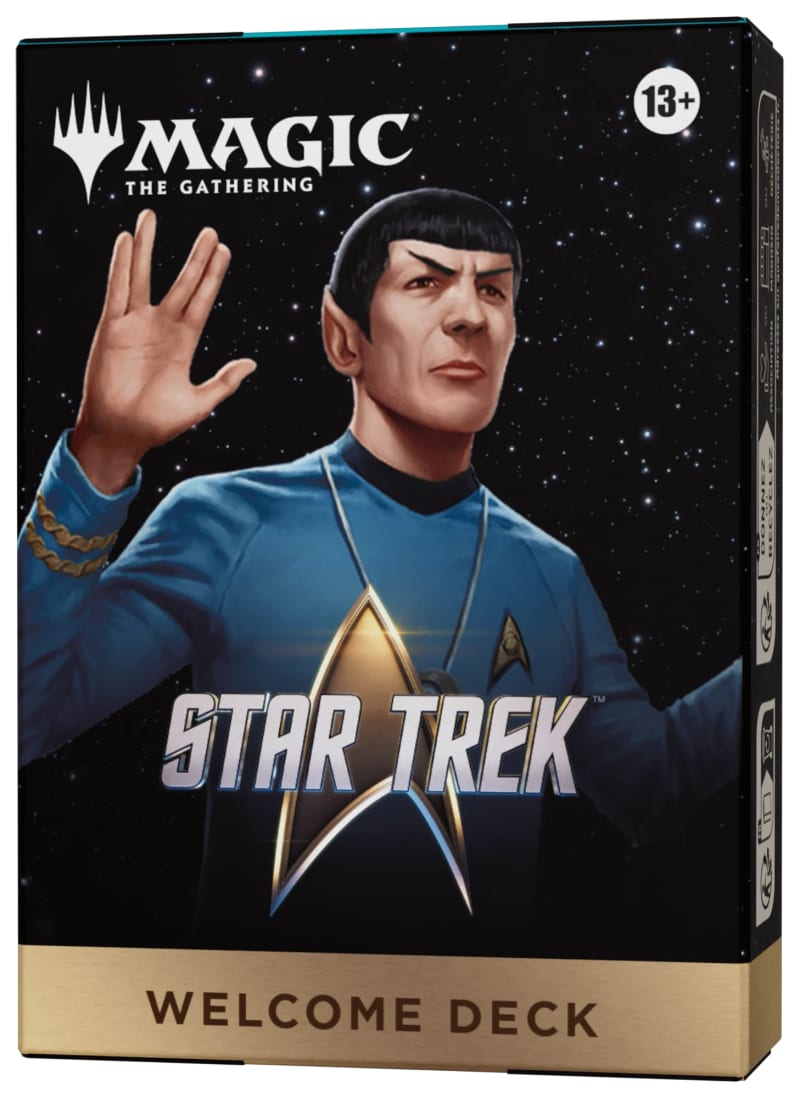
Blue Star Trek Welcome DeckOfficial product image via Wizards of the Coast (opens in a new tab) 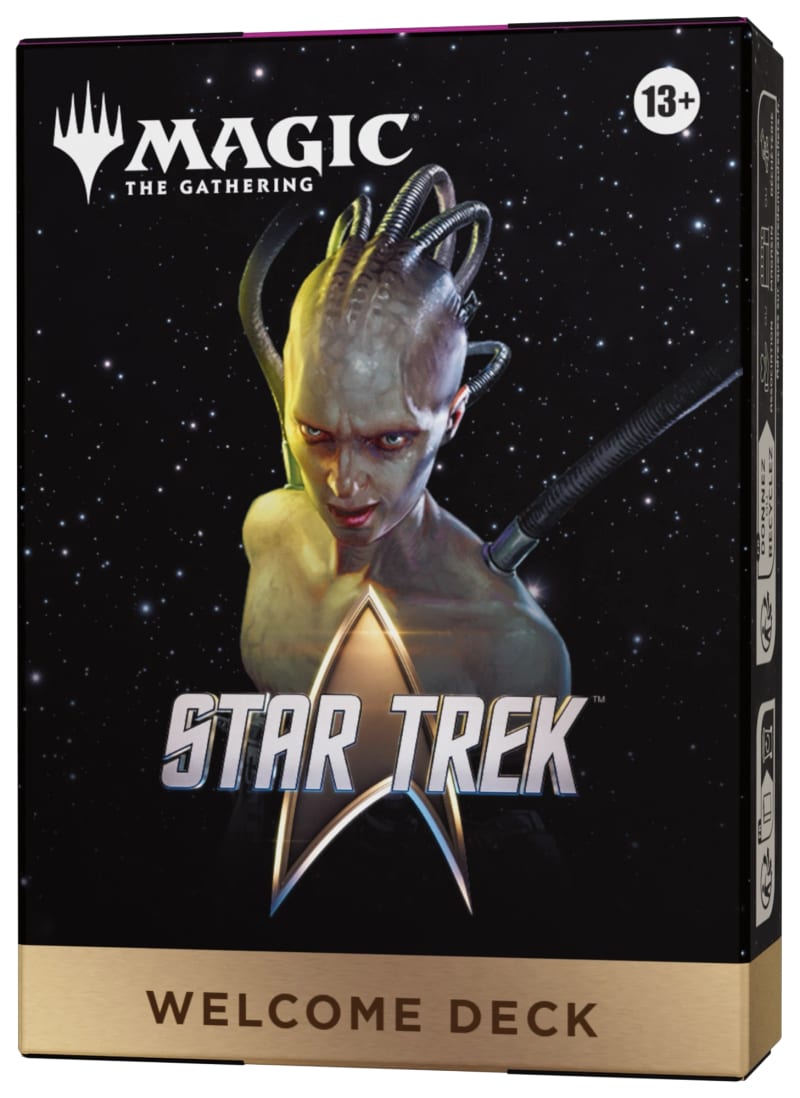
Black Star Trek Welcome DeckOfficial product image via Wizards of the Coast (opens in a new tab) 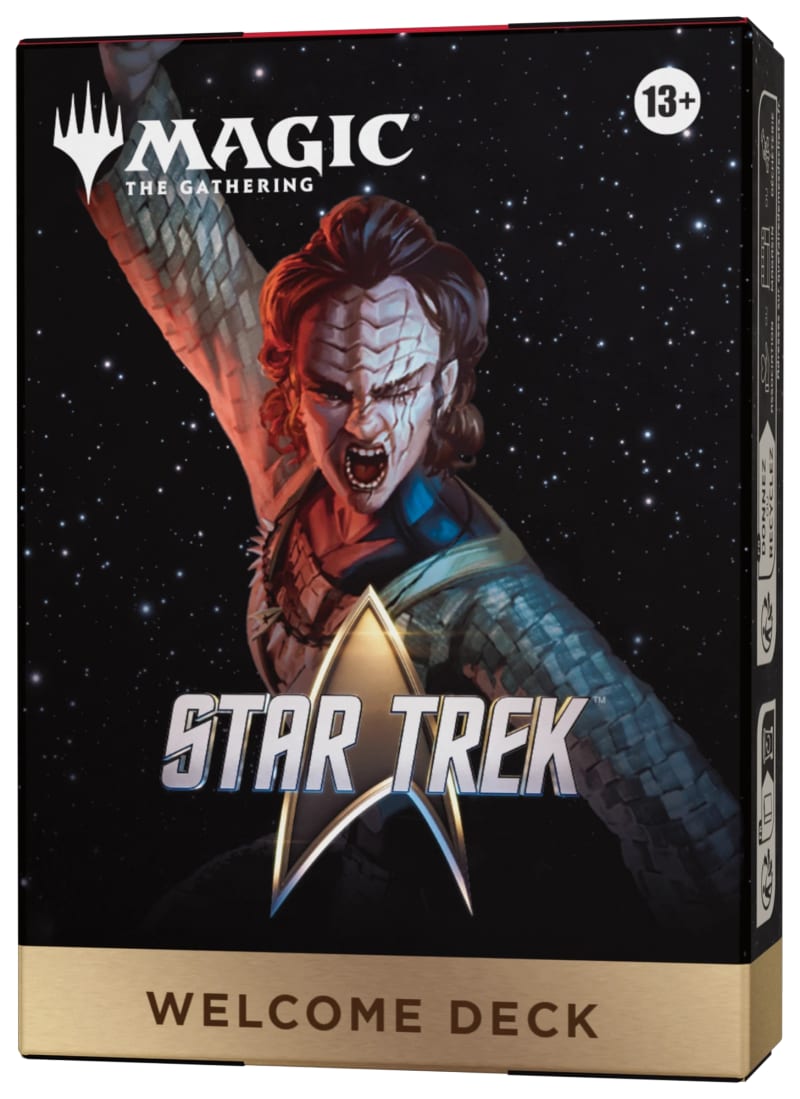
Red Star Trek Welcome DeckOfficial product image via Wizards of the Coast (opens in a new tab) 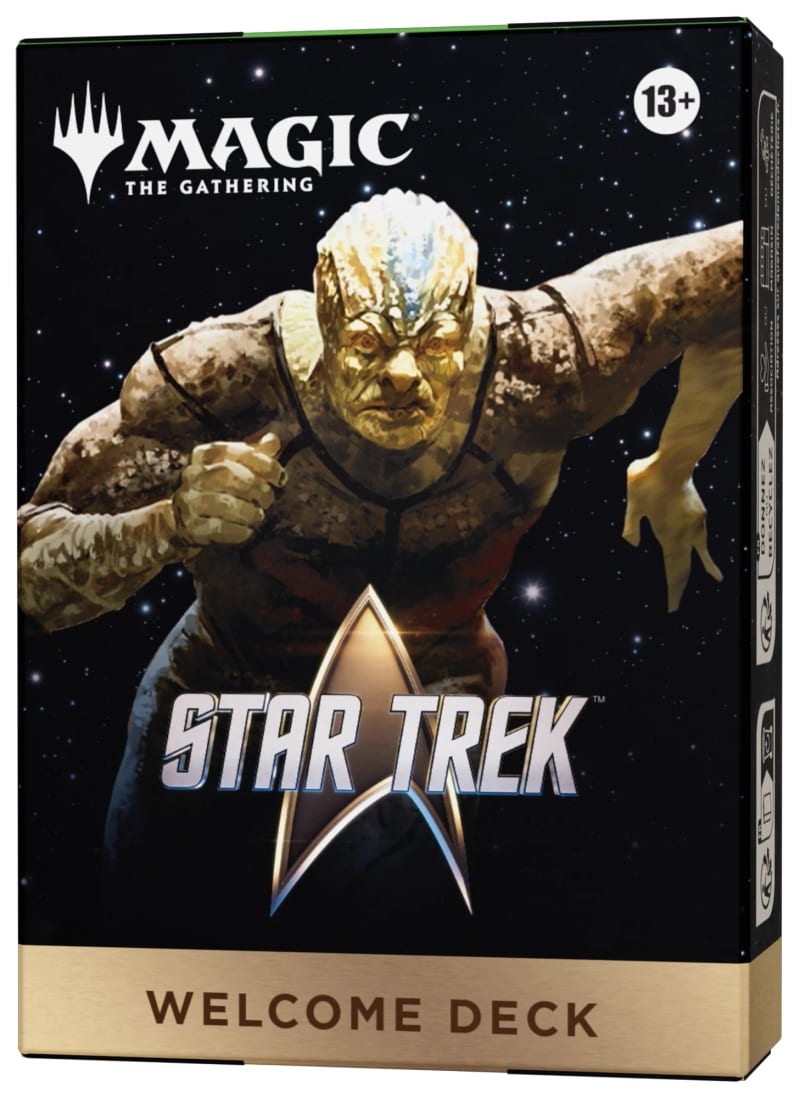
Green Star Trek Welcome DeckOfficial product image via Wizards of the Coast (opens in a new tab)
Two Scene Boxes make fixed displays
Enterprise-Q and Divergent Timeline are the two confirmed Scene Boxes. Each contains six traditional foil borderless, new-to-Magic scene cards whose art forms a larger image, six art cards, three Play Boosters, and a display easel. Nonfoil versions of those twelve Scene Box cards appear in Collector Boosters.
Choose a Scene Box when one of those two fixed panoramas is the point. It is more predictable than chasing the nonfoil versions in Collector Boosters, and its six art cards and easel support display rather than deck construction.
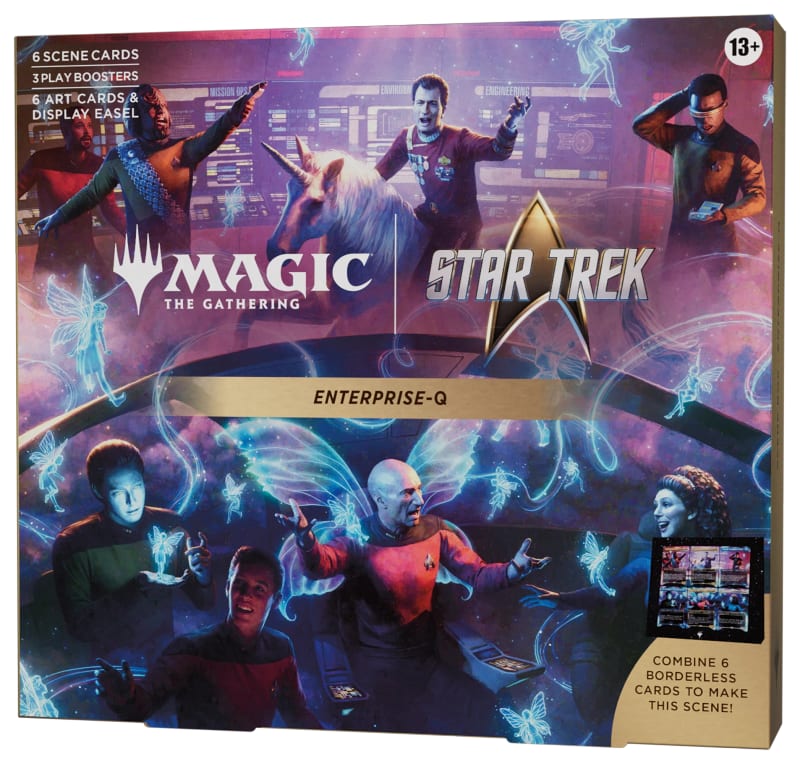
Enterprise-Q Scene BoxOfficial product image via Wizards of the Coast (opens in a new tab) 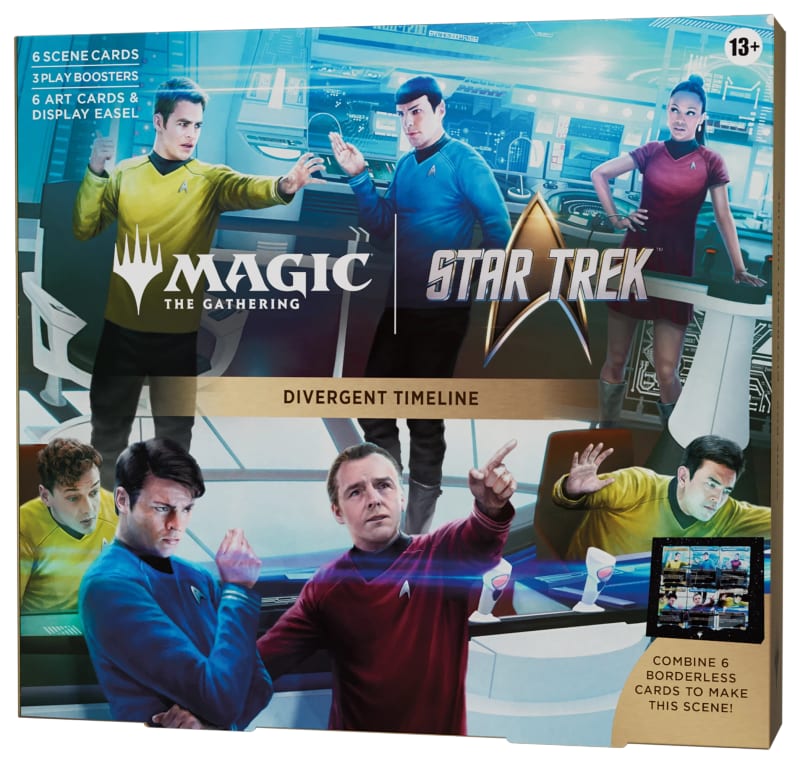
Divergent Timeline Scene BoxOfficial product image via Wizards of the Coast (opens in a new tab)
A worked choice for four-player Draft Night
Suppose four Star Trek fans already know Magic and want one evening of Booster Draft, basic lands for deck building, and a premium prize. A normal three-pack-per-player draft requires exactly 12 Play Boosters.
At Wizards’ listed U.S. MSRP (opens in a new tab), 12 individual Play Boosters cost 12 × $6.99 = $83.88. Add one $37.99 Collector Booster, and those packs total $121.87. The named Draft Night product has an MSRP of $119.99 and already contains those 12 Play Boosters and one Collector Booster, plus 90 basic lands, ten double-sided tokens, and the draft insert. It supplies the complete four-player setup for $1.88 less than the two booster types at individual MSRP.
The result follows the event, not a general claim that one box is best. The Beginner Box is better for teaching two first-time players. A Commander deck is better for joining a Commander table immediately. The Beam Me Up Bundle is better when spacecraft schematics and a mixed booster opening are the gift’s main attraction. The broader MTG product-choice guide applies the same goal-first method across releases.
Confirmed treatments and signed Headliners
The first-look treatment guide (opens in a new tab) confirms several visual collection lanes. Keep finish, frame, and fixed-product promo categories separate. Our MTG card treatments guide explains why a Surge Foil finish and an LCARS frame are two different attributes even when they appear on the same card.
Signed Headliners are a Collector Booster chase
There are seven signed Headliner cards, with approximately 250 copies of each. Wizards says the printed cards were individually hand-signed by the actors who portrayed the characters and randomly inserted into Collector Boosters. They can appear in Collector Boosters of any language, but the signed cards themselves are English only. A Headliner is mechanically identical to another TRK treatment of the same card.
Wizards has revealed only part of the Headliner lineup. The complete seven-card subject and signer list has not yet been published.
Stardates is the SDS reprint lane
The 30 Stardates cards pair recognizable Magic reprints with Star Trek art. Nonfoil Stardates cards appear in Play and Collector Boosters; traditional foil versions appear only in Collector Boosters.
Collect SDS as a reprint sheet, not as 30 new TRK designs. The underlying Magic card determines constructed legality even when the Star Trek presentation uses a character-facing name.
LCARS, Classic Enterprise, and scenes have documented pack routes
There are 29 LCARS frame cards and ten LCARS shock lands, one for each shock land. Nonfoil and traditional foil versions appear in Play and Collector Boosters; Surge Foils are Collector Booster-only.
The 24 Classic Enterprise cards use a textured, painterly poster style inspired by The Original Series. They follow the same distribution pattern: nonfoil and traditional foil in both booster types, Surge Foil only in Collector Boosters.
The main booster line also contains 25 borderless scene cards across four scenes. Those appear in nonfoil and traditional foil in both Play and Collector Boosters. The twelve different cards from the Enterprise-Q and Divergent Timeline Scene Boxes are a separate scene group: the boxes hold the traditional foils, while Collector Boosters hold nonfoil versions.
Klingon Script and Away Team details are still partial
Wizards’ product page confirms Klingon Script cards as a Collector Booster attraction, but the first-look collecting guide does not yet provide their count, full appearance list, or detailed slot distribution. It also confirms Full-Art Away Team lands in the Beam Me Up Bundle without publishing the complete art checklist. Those names are confirmed; a complete treatment map is not.
What Wizards has not announced yet
The sealed-product structure is settled enough to choose a path, but several facts should remain open until Wizards publishes them:
- the full TRK, TRC, and SDS card galleries and rarity breakdowns
- complete Commander decklists, color identities, and alternate commanders
- the remaining signed Headliner subjects and complete signer list
- full Klingon Script and Away Team land checklists and their exact distribution
- the identities of all four main-set scenes and every Scene Box card
- detailed odds for premium treatments beyond the distribution Wizards has already stated
- one of the two Standard Showdown promos and the announced Spotlight Series promo
- broader Welcome Deck availability beyond participating stores and events
Do not fill those spaces with leaked lists, assumed franchise coverage, or product behavior copied from another Universes Beyond set. Wizards’ Star Trek card image gallery (opens in a new tab) is the right checkpoint as previews expand.
The shortest buying answer
- For Draft or Sealed: buy Play Boosters, Draft Night, or the Prerelease Pack that matches the event.
- For Standard deck building: start with TRK cards, then verify the specific card against the current format list.
- For ready-to-play Commander: choose Federation Fleet, Landing Party, Klingon Fury, or We Are the Borg by strategy, then choose standard or all-Surge-Foil Collector’s Edition.
- For two new players: choose the Beginner Box, or ask a participating game store about Welcome Decks.
- For a general gift: choose the Bundle. For a spacecraft-focused premium gift, choose the Beam Me Up Bundle.
- For a fixed display: choose Enterprise-Q or Divergent Timeline rather than opening random packs for the same traditional foil scene cards.
- For signed Headliners, Surge Foils, traditional foil Stardates, or Klingon Script cards: Collector Boosters are the confirmed route.
That purchase map can be decided now. The exact card-by-card collector checklist should wait for the complete gallery and release materials.