
Set & card guides
Magic: The Gathering | Doctor Who: A Commander and Collector Guide
A collector's guide to Magic: The Gathering | Doctor Who, covering the four Commander decks, Planechase cards, TARDIS treatments, and serialized Doctors.

The Doctor Who crossover is a Commander release first and a sealed-product release second. Wizards of the Coast and the BBC launched it on October 13, 2023 with four preconstructed 100-card decks, forty Planechase cards spread across those decks, and Collector Boosters for the people who want showcase frames and serialized Doctors. The official product page (opens in a new tab) makes the division clear: there is no draftable booster set to assemble before the decks make sense.
An era or villain group can determine the first purchase: choose its deck and the crossover arrives as a complete Commander experience. Collector Boosters instead supply TARDIS frames, Surge foils, and reprints, while the three Secret Lair drops sit beside the main release rather than filling gaps in the decks. Planechase is packed into every deck, so its oversized cards and planar die belong in the completeness check as firmly as the 100-card list.
Start with the four decks
Each Commander deck supplies a ready-to-play 100-card list, two traditional foil legendary commanders, a foil-etched display commander, ten double-sided tokens, ten oversized Planechase cards, a planar die, a Collector Booster Sample Pack, a deck box, and a life tracker. Each deck contains 50 new-to-Magic cards, so buying all four is the straightforward route to the main release’s regular playable card pool, with each deck’s face and featured commanders supplied in traditional foil.
The four decks are deliberately different products in one lineup:
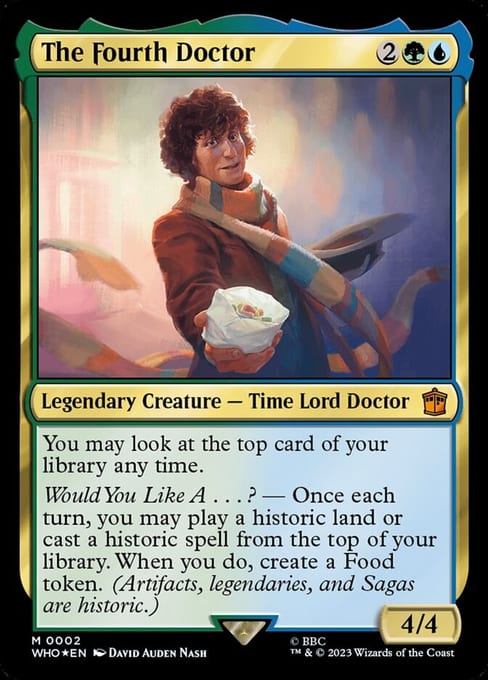
- Blast From the Past is Bant and looks back to Doctors One through Eight. Historic permanents, Food, and Clues give the classic era a value-oriented frame. The Fourth Doctor and Sarah Jane Smith lead a deck that rewards playing historic cards from the top of the library.
- Timey-Wimey is Jeskai and centers on Doctors Nine through Eleven. The Tenth Doctor and Rose Tyler make suspended cards and time counters the deck’s main resource, so the deck’s best turns come from manipulating spells that are already waiting in exile.
- Masters of Evil is Grixis and gives the villains their own deck. Davros, Daleks, Cybermen, and villainous choice turn life loss and difficult decisions into a steady stream of pressure.
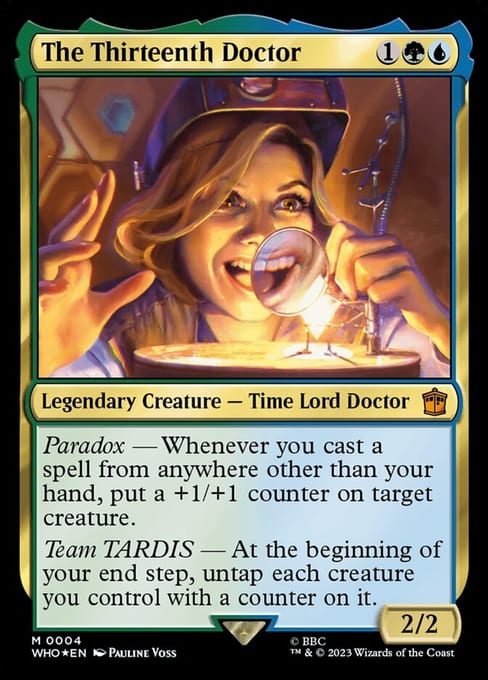
- Paradox Power is Temur and focuses on Doctors Twelve and Thirteen. It rewards spells cast from somewhere other than the hand, then turns counters and exile-based casting into a larger board.
Those themes are better buying guides than the deck names alone. Choose Blast From the Past for historic value, Timey-Wimey for suspended spells, Masters of Evil for villain tokens and forced choices, or Paradox Power for casting from exile and manipulating counters. The distinction remains useful even if you later rebuild the deck with singles.

Timey-Wimey Commander DeckOfficial product image via Wizards of the Coast (opens in a new tab) 
Paradox Power Commander DeckOfficial product image via Wizards of the Coast (opens in a new tab) 
Masters of Evil Commander DeckOfficial product image via Wizards of the Coast (opens in a new tab) 
Doctor Who Collector Booster DisplayOfficial product image via Wizards of the Coast (opens in a new tab)
Collector Boosters and the TARDIS frame
Collector Boosters are the only booster product attached to the main Doctor Who release. They contain 15 cards and are sold in 12-pack displays. The collecting guide (opens in a new tab) details their foil slots, extended-art cards, TARDIS showcase cards, and Surge Foil variants.
The TARDIS showcase frame is the visual center of the set. Its blue police-box treatment puts the card in the Doctor’s machine rather than using a generic alternate border. It is a good collection lane for a favorite Doctor, companion, or villain because the frame unifies cards from different decks without erasing their individual eras.

Collector Boosters also contain the serialized Doctors, with the First through Thirteenth Doctors printed in the TARDIS frame and numbered out of 500. That is a distinct display project from collecting the four decks. A deck buyer needs the ordinary card pool; a TARDIS collector can focus on the treatment and leave most of the sealed product unopened.
The three Secret Lair companion drops have their own boundaries as well. The Weeping Angels, The Dalek Lands, and Regeneration add cards tied to particular stories and later Doctors, but they are not extra Planechase cards in the four main decks. Keep them in a separate section of a checklist so the main Commander release stays legible.
Planechase is part of the product, not an afterthought
Every deck contains ten oversized Planechase cards and a planar die. Across the four decks, the release includes 36 Plane cards and four Phenomenon cards. The Plane cards depict locations such as Gallifrey, Bad Wolf Bay, the Doctor’s Tomb, Lake Silencio, Pompeii, and Trenzalore. The planar cards change the rules of the table when a group rolls the die, making the game feel more like a moving Doctor Who episode than a fixed battlefield.
This matters when you buy a preowned deck. A box with its 100 cards but without its oversized Planechase cards is not the same play experience. Check the planar cards and die separately, and store the oversized pieces so their corners do not spend the life of the deck pressed against ordinary cards.
The Planechase cards also help explain why Doctor Who should not be compared with Fallout’s faction decks or a conventional booster set. Wizards built the setting into the play surface, not only into card names and art.
The mechanics of a time-travel game
The Doctor Who mechanics article (opens in a new tab) gives the rules framework. The practical question is how those mechanics change a deck’s rhythm.
Doctor’s companion creates a two-card identity
Doctor’s companion works like a specialized Partner ability. A legendary Time Lord Doctor with no other creature types can pair in the command zone with a legendary creature that has Doctor’s companion. A changeling such as Morophon has every creature type, so it can never be the Doctor half of the pair. Rose Tyler, Sarah Jane Smith, Yasmin Khan, and other companions therefore do more than add flavor. They determine the deck’s second color identity and give a deck a different opening hand from another deck led by the same Doctor.
When comparing decklists or singles, read the pair as one plan. The Tenth Doctor’s time-counter engine needs Rose’s identity and growth pattern to play as intended, while the Thirteenth Doctor’s counter plan pairs with Yasmin Khan and her exile-based access to spells. Deployment speed separates them: the Tenth Doctor arrives two turns later than the Thirteenth, so its deck needs earlier plays to stay busy while the pair assembles.

Suspends nonland cards from the top of the library. 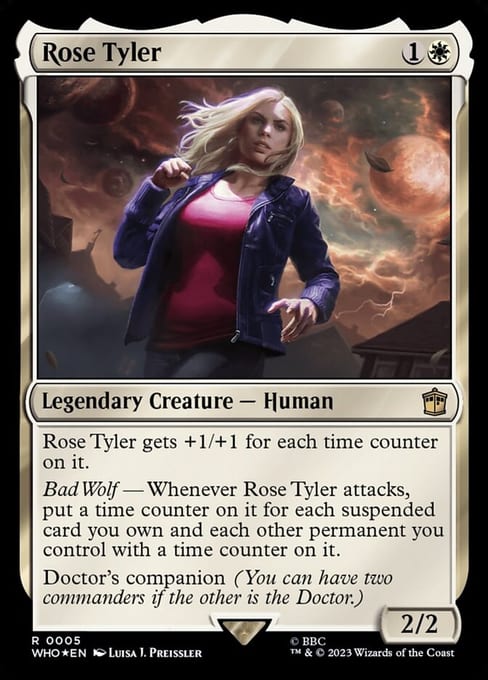
Grows from time counters and supplies the pair's second color identity.
Time travel changes the clock
Time travel lets you add or remove time counters from suspended cards and permanents you control with time counters. Removing a counter brings a suspended spell closer to casting, but removing the wrong counter can also change when a vanishing permanent leaves play. The mechanic rewards a player who tracks several clocks at once instead of treating exile as a waiting room.
Paradox rewards casting from unusual places
Paradox is an ability word for spells cast from exile, the graveyard, the command zone, or the top of the library. It turns a spell’s origin into a trigger. That is why the release’s exile and top-of-library effects feel connected even when they appear in separate decks.
Villainous choice keeps the opponent involved
Villainous choice asks an opponent to choose between two bad outcomes. Davros, Dalek Creator (opens in a new tab) is the clearest example: once the required life loss has happened, he creates the Dalek first. The qualifying opponent then chooses between letting you draw or discarding a card. Board presence is guaranteed; only the second reward is negotiable.
Cards worth using as reference points
A few cards show the release’s range better than a long list of names.
The Fourth Doctor is a good reference for Blast From the Past because it rewards a historic permanent or spell played from the top of the library and makes a Food token when that plan succeeds. It asks for a deck with enough artifacts, legends, and Sagas to keep the top of the library useful.
The Tenth Doctor and Rose Tyler explain why time counters are not a cosmetic theme. The Doctor suspends nonland cards from the top of the library, while Rose grows from time counters on herself. Their pairing makes the deck’s delayed spells and combat pressure point in the same direction.
The Thirteenth Doctor rewards spells cast from outside the hand, then untaps each creature you control with a counter at the end step. That “each” matters when the deck has built a board. Yasmin Khan provides the red identity and exiles cards for a later turn, giving the deck a reliable way to create those outside-the-hand casts.
Davros, Dalek Creator guarantees a Dalek once the life-loss threshold is met, then leaves the opponent to choose between your draw and their discard. TARDIS (opens in a new tab) separates its two attack payoffs when you control a Time Lord: the next spell you cast that turn gains cascade, and you may planeswalk. The attack unlocks the spell benefit; it does not itself cascade. Sonic Screwdriver is a quieter showcase for the setting: one artifact offers mana, scrying, untapping, and a way to make a creature unblockable.
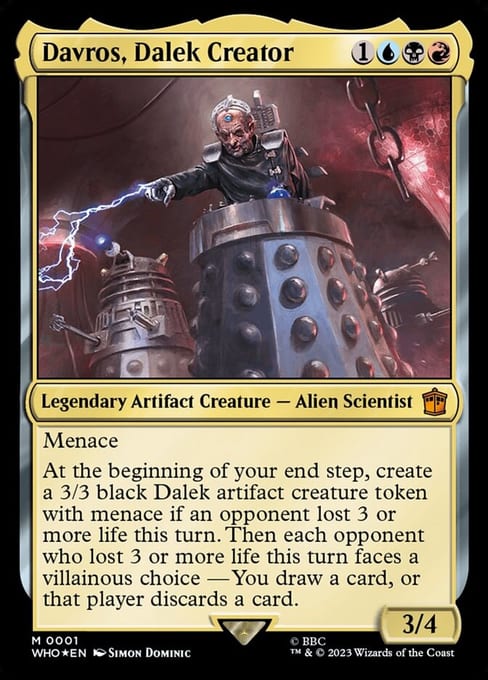
The Dalek arrives before villainous choice; the opponent decides only between your draw and their discard. 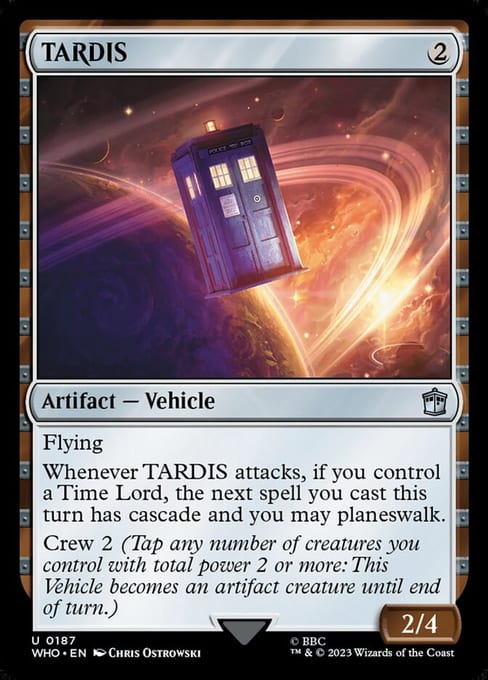
Its attack trigger gives the next spell cascade and separately offers a planeswalk while you control a Time Lord. 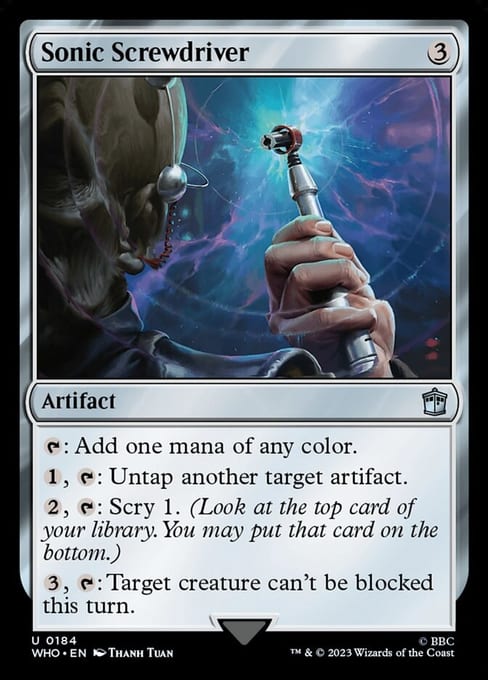
Mana, scry, untap, and unblockable sit on one artifact rather than a creature.
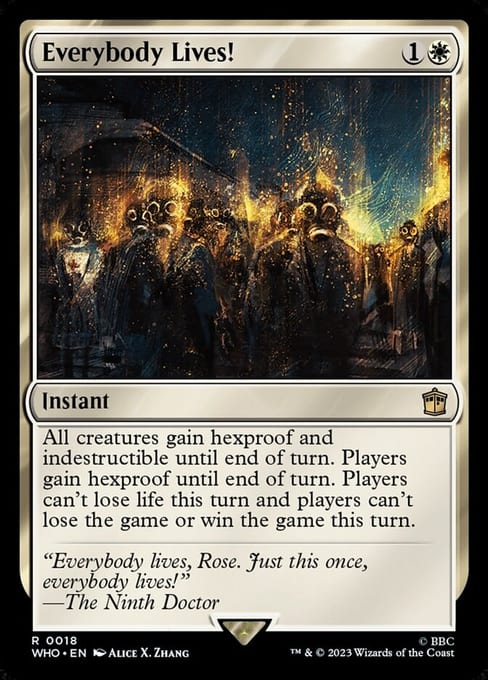
Everybody Lives! demonstrates the release’s interest in dramatic table resets. It protects creatures and players from several ways a game can end for a turn, which is more useful to understand as a timing tool than as a card to rank in isolation.
A collector’s buying checklist
- Choose a deck by play pattern. Classic Doctors, modern time counters, villains, and exile-based casting are four different reasons to buy. Start with the one you will actually play or display.
- Check Planechase contents in opened product. Count the ten oversized cards and confirm that the planar die is present. The cards belong to the play experience and are easy to overlook in a marketplace listing.
- Separate ordinary cards from treatments. The four decks provide the new-to-Magic card pool in their regular deck printings, including two traditional-foil commanders per deck. TARDIS frames, Surge foils, and serialized Doctors are Collector Booster projects.
- Decide how to handle Secret Lair cards. Keep The Weeping Angels, The Dalek Lands, and Regeneration in a companion checklist rather than treating them as missing deck cards.
- Inspect foils and oversized cards as different objects. Foils deserve the surface and edge checks in our Magic Card Condition Guide, while oversized Planechase cards need corner and bend checks. For secondary-market listings, How to Read an MTG Marketplace Listing covers the details a seller should show.