
Set & card guides
Magic: The Gathering Set Symbols, Codes, and Collector Numbers Explained
A practical field guide to identifying exact Magic card printings with set symbols, set codes, and collector numbers.
The expansion symbol is a useful first clue, but it is not an inventory number. Modern Magic can put a regular card, a showcase variant, a bonus-sheet card, and a promo beside one another in the same product while giving each a different identity in a card database. If you are buying a single, sorting a collection, or checking a card before a trade, the small line at the bottom of the card is the reliable place to start.
Three details do most of the work: the collector number, the set code, and the release context. Together they point to the card record or illustrated variant. They do not, by themselves, tell you every physical attribute. Finish, language, condition, and promo markings still need their own check.
What the expansion symbol can and cannot tell you
The expansion symbol sits on the right side of the type line. It can connect a card to a release at a glance, and its color often gives a rough rarity cue. That is useful across a table. It is not enough for a marketplace listing.
A set can use its ordinary symbol on several printings of the same card. A regular-frame card and a borderless alternate-art card may share the symbol even though they have different collector numbers. Supplemental cards and promos can also use symbols that are less familiar or reused in different contexts. The symbol identifies a visual family; it does not settle the exact printing.
For older cards, the symbol may be the best clue available on the cardboard. Exodus-era cards introduced rarity colors, and the modern printed set code arrived much later. When the card has no printed code or collector number, art, border, copyright line, and the symbol work together. Databases can still assign retroactive set codes and numbers, but those fields are not printed evidence from the card itself.
Find the collector number first
On a modern card, begin at the bottom edge rather than the expansion symbol. The information line pairs the collector number with a rarity letter, then gives the set code and the language code on the row beneath.
How that line appears depends on the era and the specific release, so verify the exact printed string rather than assuming a universal layout pattern:
- Number-first with a set total: Printings such as
060/269 Con Dominaria (DOM) or099/302 Ron Kamigawa: Neon Dynasty (NEO) place the card number and main-set total before the rarity letter. - Standalone variant numbers: Certain variants from that same era omit the total, printing the number alone as in
415 Ron Kamigawa: Neon Dynasty. - Rarity-first without set totals: Recent printings such as
M 0287on Outlaws of Thunder Junction (OTJ) orR 0001on its Breaking News (OTP) bonus sheet lead with the rarity letter and use zero-padded numbers with no printed set total.
The collector number helps separate versions of the same named card. A regular printing might be number 150, while a borderless, extended-art, or showcase version has a later number. Databases go a step further and file a promo under its own set code and a suffixed collector number, even when the cardboard prints only the main code and a plain number. The Aetherdrift Prerelease copy of Loot, the Pathfinder prints M 0212 over DFT ★ EN, but Scryfall records it as set pdft, collector number 212s. The query set:pdft cn:"212s" finds it; set:dft cn:212s matches nothing, because the printed code is not the code the promo is filed under. The star in that line marks a traditional foil, not the Prerelease status; the gold date stamp in the art box is the mark that records how the copy was distributed. Always confirm the exact printed information line against the database record for that specific printing rather than inferring metadata from an assumed layout pattern.
The number is not a finish field. One card record can have both nonfoil and traditional foil copies. A number that matches your search result gets you to the right card or art variant; you still need to compare the surface and confirm the finish.
What a set code really identifies
The set code is the short, machine-readable identifier printed near the bottom of a modern card. It commonly has three letters, although database identifiers can include digits or run longer. It separates a main set from a Commander subset, bonus sheet, or other named group. For example, Kamigawa: Neon Dynasty uses NEO, its Commander subset uses NEC, and The Lord of the Rings: Tales of Middle-earth uses LTR alongside its Commander subset LTC.
Treat the code as a database key, not as a universal release name. SPG, the Special Guests identifier, is reused across multiple releases. Pair it with the collector number and the release you opened when the code is reused. Scryfall’s card-object documentation (opens in a new tab) makes the same distinction by keeping set, collector number, finishes, frame data, and promo data as separate fields.
A single pack can contain cards from more than one set or subset. In Outlaws of Thunder Junction, the newspaper-style Breaking News cards use OTP, while wanted-poster cards are Booster Fun variants of the main OTJ set. The set code helps separate those two cases. A List card from a release that used The List can retain the code and number of its original printing instead of receiving a new List code, so the wrapper alone cannot identify it. Databases still separate those copies: the List printing of Lightning Bolt prints 187/361 C over CLB • EN from its Commander Legends: Battle for Baldur’s Gate printing, while Scryfall files it under set plst at collector number CLB-187.

A wanted-poster card is a Booster Fun variant of the main OTJ set. 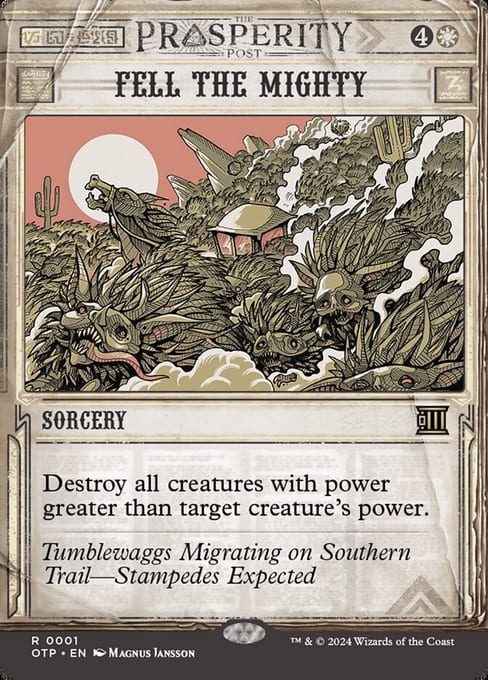
Breaking News uses OTP, a separate subset code, even when opened in the same product.
The important habit is to identify the subset before making a legality assumption. A card from the main set and a card from a bonus sheet can be opened together while following different legality rules. Use the release’s official collecting guide for Murders at Karlov Manor (opens in a new tab) as a concrete example of how one product can contain differently identified cards. Current products change their slot structure, so do not turn one release’s arrangement into a general rule.
Search the pair in Scryfall
Scryfall’s search syntax (opens in a new tab) lets you search the printed data directly. Use set: for the set code and cn: for the collector number, and keep every special character in the number exactly as the database records it. Wrap a number that carries a letter suffix in quotes, as in cn:"212s": unquoted, Scryfall reads the suffix loosely and can drop it, so set:pdft cn:212 returns the Promo Pack copy at 212p rather than the Prerelease copy you asked for. For a main-set card those two values match the printed line. For a promo or a List copy they often do not, so when the printed pair returns nothing, search the card by name and read the database set code and suffixed number off the record you want.
Suppose the bottom line reads NEO and 415. The query set:neo cn:415 finds Sokenzan, Crucible of Defiance, the card at that number. It is a good example of why the number matters: the query does not find the similarly memorable NEO card you may have had in mind. Hidetsugu, Devouring Chaos is number 99 in the main NEO set, so its query is set:neo cn:99.
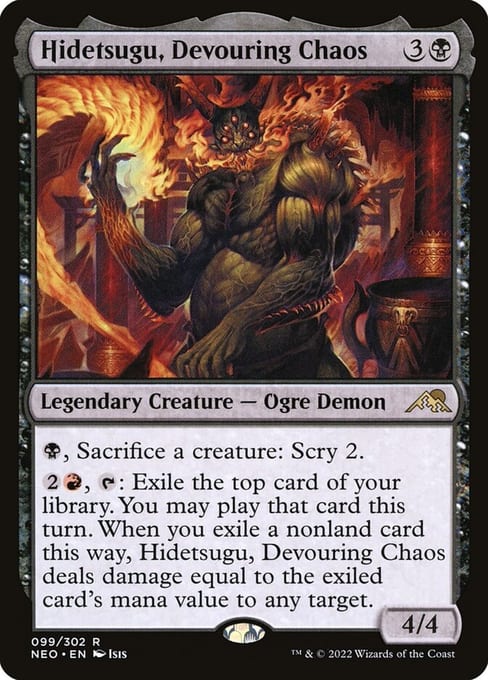
NEO 99 sits in the main numbered sequence. 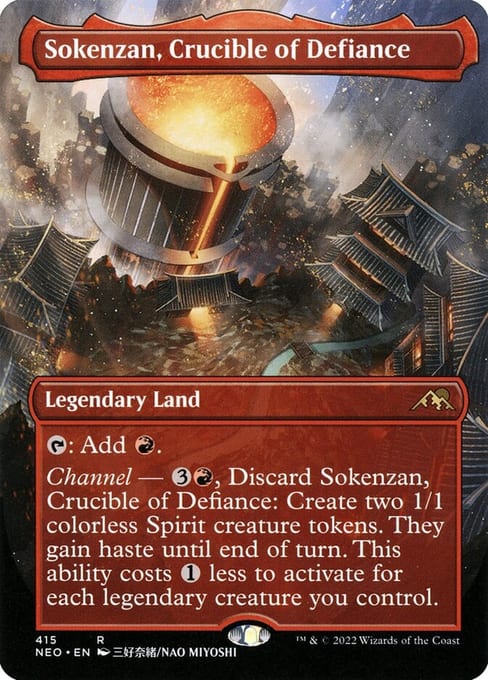
NEO 415 is a later-numbered borderless land, not whichever memorable NEO card a name-only search might have assumed.
Once the result opens, compare the art and frame to the card in your hand. Then check the listed finish and promo details. The query identifies a record or illustrated variant; it does not magically inspect the surface of your physical copy.
Range searches are useful for sorting a known variant run. If a release guide says extended-art cards occupy a particular block, a query such as set:xyz cn>=300 cn<=350 can narrow the results. Replace xyz and the range with the real code and numbers for the release you are cataloging.
A buying and selling workflow that works
Use this order when a card matters:
- Read the complete collector number from the bottom line.
- Read the set code and note the release or subset, especially for a code such as
SPG, and expect a promo or List copy to be catalogued under a different code than the one printed. - Search both fields together in Scryfall or the marketplace’s printing filter.
- Compare the art, frame, border, and any promo stamp with the result.
- Confirm finish and language separately.
- On a listing, check condition and seller terms after the identity matches.
This prevents a common marketplace mistake: finding the right card name but buying the wrong printing. A seller can list a card under the correct name while the image, set, collector number, or finish points somewhere else. How to read an MTG marketplace listing covers the rest of that check, including condition and seller details.
The same workflow helps with collection software. Store the database set code, full collector number, finish, language, and promo status as separate values. Do not use the expansion symbol as a substitute for all five.
Older cards need a different approach
Cards printed before the modern information line require more visual detective work. Use the expansion symbol, border color, art, copyright date, and any differences in rules text or frame. An Alpha Black Lotus does not have LEA and 232 printed on the card, but a database can still use set:lea cn:232 to describe that printing.
That distinction matters when checking a vintage card: a database query can point you to the right record, while the physical card still needs an inspection against that record. The absence of a printed code is normal for older cards, not evidence that the card is mislabeled.
The short version
The expansion symbol is the quick visual hint. The collector number distinguishes the card or variant within a set. The set code narrows the record to a set or subset. Release context resolves reused identifiers, and finish or promo markings complete the physical identification.
Read the bottom line, search the exact pair, and compare the result with the cardboard in front of you. That small habit is more dependable than memorizing a wall of symbols, and it gives a buyer or seller the precise information a card name leaves out.