
Collecting & grading
Sleeves, Binders, and Toploaders: What Each One Actually Does for Magic Cards
A plain-language map of inner sleeves, play sleeves, binder pages, toploaders, and magnetic holders, including PVC vs polypropylene and when each layer helps or hurts.
The right accessory depends on the next thing that will happen to the card. A play sleeve handles shuffling. A binder handles browsing. A toploader handles a trip through the mail. None of them is automatically a good long-term home, and the plastic touching the card matters more than the word “premium” on the package.
Here is the useful order: card, inner sleeve, optional play sleeve, then a binder page or rigid holder. The room and box around that stack still matter, so pair this guide with long-term Magic card storage.
Start with fit
Magic cards use the standard size that sleeve makers also call poker size, about 63 by 88 mm or 2.5 by 3.5 inches. The Dragon Shield size and sleeve FAQ (opens in a new tab) distinguishes that standard size from Japanese-size sleeves, which are narrower. Buy for the card, not for the name of the game on a mixed-size shelf.
Thickness is a second measurement. A 35-point holder is meant for a typical trading card and a thin sleeve. It is not a promise that a double-sleeved Commander deck, a thick inner sleeve, or a card with an unusual treatment will slide in safely. If the opening catches a corner, stop. A larger holder is cheaper than a damaged edge.
The layers have separate jobs:
- Inner sleeve: keeps dust and fingerprints off the card and takes the first scuffs.
- Play sleeve: gives a deck a consistent back and a durable surface for shuffling.
- Binder page: lets you see and sort cards while they remain in pockets.
- Rigid holder: resists bending and protects a card during handling or shipping.
- Box or cabinet: provides darkness, support, and a stable environment.
Skip a layer when it has no job. Do not skip a layer that prevents a card from touching a harder or less stable material.
Inner sleeves protect the surface
An inner sleeve is the first layer around the card. It is thin because it is not supposed to provide structural support. Its job is to keep the printed surface away from grit, fingerprints, and the next piece of plastic.
Choose a sleeve that names polypropylene or another suitable material and excludes PVC. The Image Permanence Institute’s photo-safe materials guide (opens in a new tab) explains why: plastics with plasticizers or unstable chemistry can damage image materials over time. The NEDCC enclosure guidance (opens in a new tab) identifies polypropylene, polyethylene, and polyester as the usual acceptable families and PVC as unsuitable for archival contact.
A penny sleeve has room around the card. A perfect-fit sleeve hugs it. Use one card per tight sleeve. If you force two cards into a perfect fit, the corners meet resistance before the sleeve does. Slide the card in squarely, without pushing the top corners against the opening.
Opening direction affects dust and spills. A top-loading inner sleeve stored open-end up is an easy place for dust to settle. Turn that opening down or sideways in a box, use a side-loading design, or choose a sealable inner sleeve for a card that will sit untouched for a long time. No sleeve seals the edges completely, so room conditions still matter.
Play sleeves are equipment that wears out
The colored or art sleeve on a deck is built for handling. It takes abrasion, fingerprints, and the friction of repeated shuffles so the card does not. The Dragon Shield FAQ (opens in a new tab) describes standard sleeves as polypropylene and identifies them as the regular layer over an inner sleeve.
Double-sleeving puts the inner opening toward the bottom of the outer sleeve. The two openings do not line up, so a spill has a less direct route to the card. The tradeoff is bulk. A double-sleeved deck may no longer fit a deck box designed around a single sleeve, and a tight deck box can press corners. Test the complete deck before storing it in a box.
For tournament play, consistency is part of protection. The Magic Tournament Rules (opens in a new tab) require sleeves in a deck to be identical and address opacity, reflective backs, and marked sleeves. Double-faced cards need completely opaque sleeves. A scratched or bent sleeve that identifies one card is a marked-card problem, not merely an old sleeve.
Innistrad Delver of Secrets is the plain case: one card, two faces, one collector number. The faces print different information lines, 51a/264 on the front and 51b/264 on the back, but Scryfall normalizes both to collector number 51. In a clear or translucent sleeve the transformed face is visible from the back of the deck.
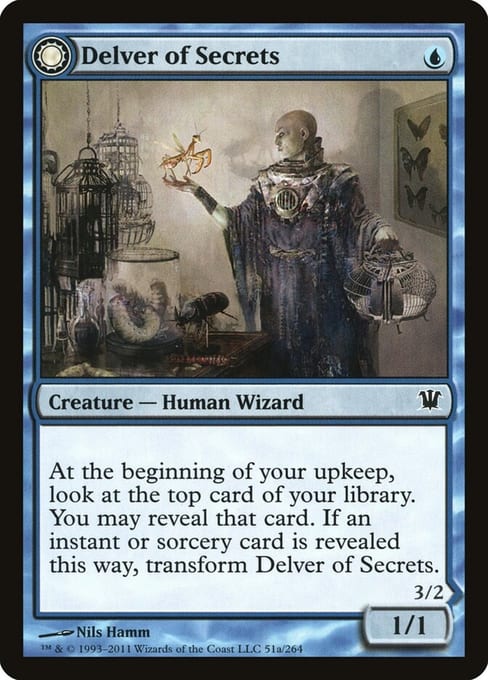
Front face, Delver of Secrets. Innistrad, printed 51a/264. 
Back face, Insectile Aberration. Printed 51b/264, the same card catalogued under collector number 51. Opaque sleeves hide this face from the deck back.
At the kitchen table, the practical version is simple:
- Use identical sleeves throughout a deck.
- Replace a sleeve when its back has a unique scratch, discoloration, split, or bend.
- Use opaque sleeves for double-faced cards.
- Keep the inner sleeve if the card’s surface matters, even when the outer sleeve is worn.
- Do not mistake an old play sleeve for archival housing. It has done its job when it is ready for replacement.
Toploaders add structure, not archival protection
A toploader is a rigid shell, usually around 3 by 4 inches, for a sleeved standard-size card. It helps with bends, edge contact, and ordinary handling. It does not create a stable climate, and many familiar toploaders are PVC.
That material distinction is the part people skip. PVC can be useful as an outer structural shell while still being a poor choice for direct, years-long contact with a card. Keep the polypropylene inner sleeve on the card. A bare card in a PVC toploader defeats the barrier that matters. Replace a holder with grit or a cloudy surface rather than trying to clean the card inside it.
Match the holder to the complete stack. A standard thin-sleeve card may fit a 35-point opening. A double-sleeved card can catch. Never force the card past resistance and never use a tight holder as a flattening press. A toploader should support a card, not squeeze it.
Sideloaders open along the long edge and make sense for some binder systems or cards that might slide out of a top opening. Semi-rigid holders flex and are often chosen for shipping or grading submissions. Magnetic cases make a clean shelf display, but the case can trap a small pocket of air and apply pressure to a curved foil. They are a format, not a universal upgrade. Display guidance covers the extra risks of a case left in view.
For mailing a card, use the inner sleeve, then a rigid holder that fits without pinching, then an outer bag or wrap that keeps grit and moisture out. The holder protects the shipment. The sleeve protects the surface.
Binders are for browsing
A binder earns its space when you will look through the cards. Choose pages that identify polypropylene or PVC-free material. Pages that do not name their plastic are unknown, not automatically safe.
Nine-pocket pages fit the standard card footprint and make set sorting easy. Side-loading pockets reduce the chance of a card sliding out when the binder stands upright. Do not overfill a pocket. A double-sleeved card in a pocket cut for an unsleeved card stresses the pocket weld and can catch a corner.
Rings create a separate failure mode. In a three-ring binder, pockets close to the rings can press against the metal and leave a curved impression, often called binder bite. D-rings or ringless zipper binders reduce that geometry. They do not make an overstuffed binder safe. Keep pages upright like books, give them room to turn, and do not stack heavy binders on their covers.
A binder is not a dark box. Every open page receives light and dust. Close it after sorting and return it to the same stable room as the rest of the collection. For the broader room and climate decision, see how to store Magic cards long term.
Choose by the next use
Weekly deck: inner sleeve plus identical play sleeves, then a deck box. Replace marked sleeves.
Set you browse: inner sleeve where the surface warrants it, then a polypropylene binder page. Keep pockets and spine loose enough that pages lie flat.
Card that rarely leaves storage: inner sleeve plus a correctly sized rigid holder, then a supported box in a stable room.
Bulk: cardboard storage box is enough if you accept ordinary scuffs. Sleeve a card when it moves into a higher-care category.
Curled foil: inner sleeve, gentle support, and a stable room. Do not force it into a rigid holder or press it under books. The foil-curling guide explains why pressure and heat are poor fixes.
Card in the mail: inner sleeve, rigid holder, and an outer barrier against grit and moisture. Check the fit before sealing the package.
A clean handoff between layers
Prepare the card on a clean, dry surface. Hold it by the edges. Collapse the sleeve opening slightly and guide the card in straight. Pushing one top corner first is how a sleeve installation becomes a permanent corner ding.
Keep rubber bands, tape, glue, paper clips, and sticky pages away from the card. The Library of Congress handling guidance (opens in a new tab) lists those materials as risks for photographs, and they bring the same adhesive, rust, and compression problems to card storage.
Write labels on boxes, pages, or sleeves, not on cards. A catalog entry should record the physical location and the printing, not just the card name. That distinction is especially useful when a binder copy and a deck copy share a name. Cataloging by set, number, language, and finish keeps the handoff between storage and inventory clear.
Before you close the box
Check the complete stack rather than judging one accessory in isolation:
- Name the next job. Shuffling calls for identical play sleeves; browsing calls for a binder; mailing calls for a rigid holder. An unused layer only adds bulk.
- Check what touches the card. Use a correctly sized polypropylene inner sleeve before a page or PVC shell. Keep tape, rubber bands, glue, and paper clips out of the stack.
- Test the fit. A double-sleeved card needs extra room. Stop if a sleeve opening catches a corner, a toploader pinches, or a binder pocket bows.
- Look for a distinguishing mark. Replace a split, bent, scratched, cloudy, or gritty sleeve or holder. Use fully opaque play sleeves when a double-faced card is in the deck.
- Return the stack to a stable place. Keep binder pages upright, inner-sleeve openings away from falling dust, and every card in a dark room with a steady climate.
If the stack fails a check, change its size, material, or housing before adding another layer.