
Collecting & grading
Why Magic Foils Curl, and What You Can Safely Do About It
Foil Magic cards curl because paper and foil layers take up moisture differently. Here is the mechanism, how to read the bend, and the safe ways to slow it without heat or heavy presses.
A foil Magic card curls because its layers respond differently to moisture. The foil face changes size very little while the paper core and back coating swell or shrink. The card bends to accommodate the mismatch. A stable room and a protective sleeve can slow the movement and sometimes let a card relax. Heat, water, chemicals, reverse-flexing, and heavy pressure can turn a bend into a crease or a damaged finish.
The safe goal is not a guaranteed uncurl. It is to stop the card getting worse.
Why the card bends
A traditional foil is a laminate: a foil or film face bonded to paper. Paper is hygroscopic, so it exchanges moisture with the surrounding air. Metal foil and many films do not respond to humidity in the same way. When one layer grows while the other stays close to its original size, the laminate curls.
That is established laminate behavior. The 1963 patent on foil-to-paper lamination (opens in a new tab) describes paper swelling against a moisture-stable foil and the direction of the resulting curl. Modern coating science uses the same two-layer model in its explanation of humidity and temperature mismatch (opens in a new tab). The sources do not promise a flat Magic card. They explain why the card reacts when its surroundings change.
Humidity is usually the main driver. Temperature changes how much moisture the air can hold and also makes materials expand at different rates. A foil that sits flat in a steady room can cup after time in a damp apartment or arch beside a winter heating vent. Nonfoil cards can warp too. Foils simply make the mismatch more visible.
Finish can matter, but it is not a cure. Scryfall’s card-object documentation (opens in a new tab) treats foil, etched, and nonfoil as distinct finish values, and its search reference (opens in a new tab) makes the same distinction. A different finish is a different physical layer. It is not evidence that one card will stay flat in every climate.
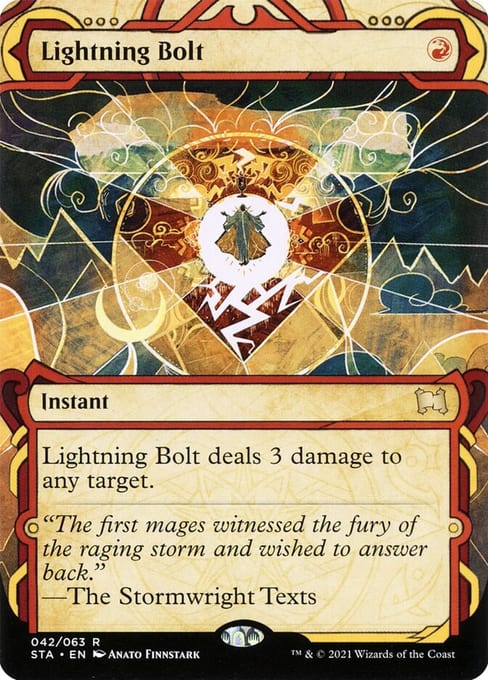
The English Mystical Archive Lightning Bolt, collector 42, is one printing with all three of those finishes. The catalog image is the same scan either way. It can help you identify the treatment. It cannot show curl, foil texture, or how the card will sit in your room.
Read the direction without touching the card
Set the card on a clean, flat surface and look at the foil face. Do not bend it in the opposite direction to confirm your guess.
Edges toward you: the foil face is on the inside of the cup. This commonly follows moisture entering the paper layer, which expands while the foil resists that change.
Edges away from you: the foil face is on the outside of the arch. This commonly follows the paper drying and shrinking relative to the foil. Dry winter air and a nearby heating vent can create this direction.
A card can twist or bowl when moisture is uneven or an edge has been constrained. The useful diagnosis is still a mismatch between layers. Curl alone does not prove a card is counterfeit, and it does not tell you that the card is beyond recovery. Treat it as a condition and handling issue. The Magic card condition guide explains how a bend fits into a broader condition description.
Start with the room, not a magic humidity number
Move the card to the same interior room you use for the collection: moderate, stable, away from sun, vents, radiators, bathrooms, cars, and unconditioned storage. The Library of Congress care guidance (opens in a new tab) recommends stable conditions for paper image materials, with roughly 30 to 50 percent relative humidity and temperatures at or below 70°F. The Northeast Document Conservation Center environmental guide (opens in a new tab) provides a similar moderate range for paper in everyday rooms.
Those ranges are preservation references, not a recipe for flattening foils. Hobby discussions often point to higher humidity as a way to make a particular foil relax. That can work differently across printings, coatings, and rooms. Chasing a number with a humidifier can push the rest of a collection toward mold-friendly conditions. Desiccant can drive another card into a tighter arch. A cigar or herb humidity packet is a product-specific experiment, not a Magic standard. Keep any such experiment away from the card and do not treat temporary flattening as a permanent repair.
Stability wins because it lets the card reach an equilibrium instead of making the layers react to a new climate every day. Put a hygrometer near the collection and watch the trend. Do not aim a humidifier or dehumidifier at a single card.
Sleeves slow change
A polypropylene inner sleeve followed by a play sleeve adds a barrier around most of the surface. That slows moisture exchange. It does not stop it because edges remain exposed and the room still reaches the card over time. Dragon Shield’s sleeve FAQ (opens in a new tab) describes polypropylene sleeves and the inner-versus-outer arrangement. The point is a slower change, not a sealed environment.
Sleeve the foil before moving it. A clean sleeve keeps grit from becoming a scratch and prevents a rigid holder from touching the card directly. If the card is already sharply curved, choose a holder with room rather than forcing the card flat. When a toploader is PVC, keep the sleeve between the holder and the card. The photo-safe materials guidance from the Image Permanence Institute (opens in a new tab) explains why polypropylene is preferable to PVC for material in contact with image surfaces.
Support the card without pressing it
A row of sleeved cards stored upright with even support gives a curl less room to tighten. Fill a box enough that cards do not slump, but not so tightly that the last card scrapes in. Isolate a badly curled foil instead of wedging it against a flat card. Support is storage. It is not a flattening press.
Time may help. A card that arrived arched from a dry warehouse can relax over days or weeks in a stable indoor room. Some cards remain curved. Some move past flat and cup in the other direction after the room changes. Check occasionally, then leave the card alone. A deadline encourages the risky intervention that does the permanent damage.
A conservative response to a curled foil
- Record the starting shape. Photograph the card on a flat surface, including the foil face and a side view in soft, angled light. Do not use the photo as a reason to handle the card repeatedly.
- Sleeve it cleanly. Use a polypropylene inner sleeve and guide the card in squarely. Never force a tight sleeve over a curve.
- Read the bend. Note whether the foil face is inside the cup or outside the arch. If the direction is unclear, skip the diagnosis and stabilize the room.
- Move it indoors. Use the collection’s moderate room, not a bathroom, windowsill, car, hot porch, or damp sealed tub.
- Give it gentle support. Store it upright with a supported row, or in a sleeved holder that does not pinch the curve.
- Wait and check. Recheck after several days and again after a few weeks. If it is relaxing, keep the conditions steady. If it starts bending the other way, stop changing the environment.
- Leave the new equilibrium alone. A foil may move again when it crosses a climate line or spends time in a hot car. Keep its storage boring.
Methods to leave out
Heat is not a shortcut. An iron, hair dryer, heat press, oven, or laminator can soften coatings, imprint sleeve texture, and produce a new warp as the card cools. There is no established home temperature that makes a Magic foil safe to heat. Do not try.
Water and chemistry damage surfaces. Soaking, steaming, solvents, and household cleaners can stain paper, haze coatings, dissolve inks, or make layers stick. A humidity-controlled room is not the same thing as wetting the card.
Pressure can trade a curl for a crease. Books, glass, clamps, and tight holders apply force at places that cannot absorb it safely. If a card will not lie flat on its own, forcing it flat is the wrong direction.
Reverse-flexing is still bending. Do not flex the card back in your hands, even for a quick playability fix. A crease is a larger condition problem than a curve.
Curl is not an authenticity test. Wizards of the Coast does not operate a public card-verification service. Its counterfeit-identification guidance (opens in a new tab) is a better starting point than a bend, water, or light test.
When the foil goes into a deck
A slight curve may fit inside a sleeve. A unique, severe curve can identify the card from the back and become a marked-card issue. The Magic Tournament Rules (opens in a new tab) address bends and marked sleeves. If one foil has a distinctive shape, replace it for sanctioned play rather than trying to conceal the bend with pressure.
A deck box protects cards from handling but does not control the climate. Do not leave a deck in a car, on a windowsill, or next to a heating vent. Return it to the same room as the rest of the collection.
Choose the least intervention
Match the response to what is in front of you:
- The room swings between damp and dry: move the card to a moderate interior room and watch the hygrometer trend before changing anything else.
- The card has a gentle curve and fits freely: sleeve it in polypropylene, support it without pressure, and check again after several days or weeks.
- The card is sharply curled: isolate it from flat neighbors and use a roomier holder. Replace it in a sanctioned deck if its shape makes it identifiable.
- Flattening would require heat, steam, water, chemicals, reverse-flexing, clamps, books, or freezing: leave the curve alone. Those methods risk permanent surface damage or a crease.
Improvement may mean a looser curve rather than a permanently flat card. Once it reaches a stable shape, keep the room steady instead of starting another correction cycle.