
Collecting & grading
MTG Proxy Cards: Commander, Casual, and Tournament Rules
Are MTG proxies legal in Commander? Learn the rules for kitchen-table games, store play, unsanctioned events, and sanctioned tournaments.

An MTG proxy is not automatically allowed or forbidden everywhere. The answer depends on what the object is and where the game is happening. A clearly unofficial playtest card may be acceptable in a private Commander game when the whole pod agrees. The same card is not an authorized game card in a sanctioned tournament. A counterfeit presented as genuine is a different problem, and a proxy issued by a Head Judge is a narrow tournament remedy rather than permission to bring homemade replacements.
For players asking “are proxies legal in Commander?”, the practical answer is: official Commander uses official Magic cards by default, but a casual group can unanimously agree to an exception for its own game. A store or event can set stricter rules, and sanctioned tournament policy overrides a pod’s house agreement. Here, “legal” means permitted in the game or event, not a conclusion about the laws of a particular jurisdiction.
What MTG players mean by “proxy”
Magic players use one word for several different objects. Sorting out the vocabulary prevents most arguments.
| Term | What it means | Practical consequence |
|---|---|---|
| Casual playtest card | An obvious stand-in that is not trying to look authentic | It may be used outside sanctioned play when the group, venue, and organizer permit it |
| Player-made proxy | Community shorthand for a substitute a player brings | The label does not create permission; the applicable casual or event rules decide |
| Counterfeit | A reproduction made or presented so that someone could take it for an authentic Magic card | Never treat, trade, list, or sell it as genuine |
| Judge-issued proxy | A temporary tournament replacement created by the Head Judge under specific conditions | It is valid only for the tournament in which it was issued |
| Official substitute card | A Wizards-printed helper used for a double-faced card | It follows its own tournament rule and is not general proxy permission |
Wizards’ official playtest-card statement (opens in a new tab) describes a typical playtest card as an obvious personal, noncommercial stand-in, often a basic land marked with another card’s name, without official art and without any attempt to pass as genuine. Wizards said it does not seek to police that kind of playtest use outside sanctioned events, including use in a store.
That statement does not make every object called a proxy equivalent. It draws the useful line between a transparent play aid and a counterfeit, while leaving the game or event organizer free to decide whether playtest cards are allowed.
Are proxies legal in Commander?
Under the published baseline, no. The official Commander FAQ (opens in a new tab) says normal games should use official Magic cards produced by Wizards. Its Rule Zero guidance also says a group may change the baseline by consensus, but one player cannot announce a change unilaterally.
That makes a casual Commander proxy a house-rule request. It is acceptable for a particular game only after every affected player agrees. A regular playgroup can adopt a standing policy, such as allowing obvious playtest cards or limiting how many may appear in a deck. With unfamiliar players, ask again rather than assuming the policy travels with you.
Proxy permission and deck strength are separate questions. A substitute does not make the represented card weaker. Wizards’ current Commander format guidance (opens in a new tab) treats brackets as an optional pregame matchmaking tool, so disclose both the proxies and the kind of game the deck is built to play. Agreement on one is not agreement on the other.
Owning an authentic copy also does not create a universal Commander exception. A casual group may choose an “own one, proxy another” policy, but that is still its house rule. In sanctioned play, having an authentic copy in a binder, another deck, or at home does not authorize a player-made proxy in the registered deck.
The rule in four common play settings
| Setting | Are player-made proxies acceptable? | Who decides? | Best action |
|---|---|---|---|
| Kitchen-table Commander | Yes, if everyone agrees | The host and every player | Ask before shuffling and bring a replacement plan |
| Casual store game or open play | Maybe | The store first, then the pod | Confirm the venue policy and get the pod’s consent |
| Unsanctioned event or league | Only if the published event rules allow them | The organizer and venue | Read the exact card policy before registering |
| Sanctioned tournament | No player-made proxies | The Magic Tournament Rules and tournament officials | Bring authorized cards; call a judge if a card becomes damaged |
The word “casual” is not enough to decide. The current Magic Tournament Rules (opens in a new tab) recognize both rated and casual sanctioned tournaments. Section 3.3 still requires genuine, regulation-sized, publicly released Magic cards in all sanctioned events. Ask whether the event is sanctioned, not merely whether its atmosphere or Rules Enforcement Level is casual.
A prize does not answer the question either. An unsanctioned event can award prizes, and a friendly event can still be sanctioned. The organizer should be able to state both the event status and its card policy clearly.
Kitchen-table Commander
At home, the group controls the invitation and the house rules. Ask before the game, identify how many stand-ins the deck contains, and accept a refusal without debate. If the group permits them, the represented cards still have to follow the agreed Commander construction rules, banned list, and power expectations unless the group explicitly changes those too.
Casual play at a local game store
Open play at a store has two permissions to clear. The store controls its space, and the players control whether they join the game. Wizards’ playtest-card statement does not require a store to accept proxies, and a pod cannot override a store rule.
Ask the staff a precise question: “Is this open play or a sanctioned event, and what is the store’s policy on clearly marked playtest cards?” Then ask the pod. A store may allow them at free-play tables but not in a league, or may prohibit them throughout the venue. Treat the answer as a rule for that activity, not as a permanent judgment about every game the store hosts.
Unsanctioned events and leagues
“Unsanctioned” means the Magic Tournament Rules do not automatically supply the card-admission policy. It does not mean every proxy is welcome. The organizer may allow any clear playtest card, impose a numerical limit, require an ownership condition, or require authentic cards throughout.
Use the written event announcement when possible. If it only says “proxies allowed,” ask whether that means obvious playtest cards, how many are permitted, and whether the represented cards must otherwise be legal in the format. Resolve those questions before submitting a decklist or paying an entry fee.
Sanctioned tournaments
Player-made proxies are not authorized cards in a sanctioned tournament, even if the player owns the real card or every opponent is personally comfortable with the substitute. Section 3.3 of the Tournament Rules requires genuine Magic cards, and section 3.4 reserves tournament proxies to the Head Judge.
If you are uncertain about a card, sleeve, alteration, or event status, ask the Head Judge before play begins. A pregame agreement between players cannot waive tournament policy.
A complete Commander proxy conversation
A useful pregame disclosure answers four things: how many stand-ins are present, what they represent, whether the venue or event permits them, and what you will do if anyone objects.
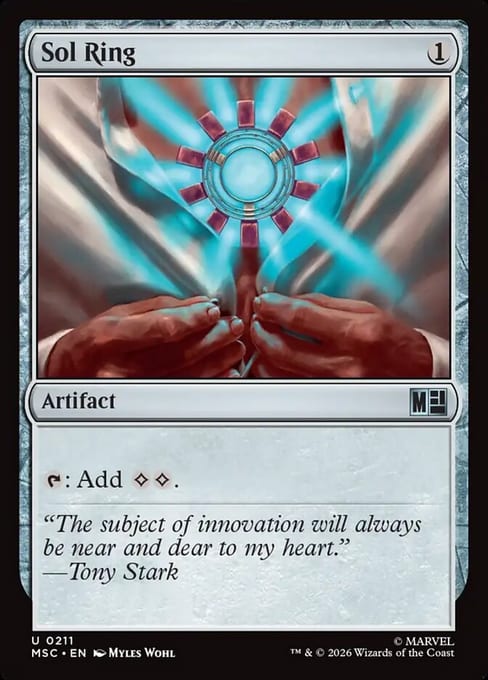
“This 100-card deck has one clearly marked playtest card representing Sol Ring. The store confirmed that tonight is unsanctioned open play and permits obvious playtest cards. Is everyone in this four-player pod comfortable with it? If not, I will replace it or use another deck. Separately, what Commander bracket or power level are we aiming for?”
This is better than asking “proxies okay?” after drawing an opening hand. It gives the other three players enough information to consent, separates card representation from deck strength, and makes the alternative clear.
Worked example: one Sol Ring at a store Commander night
Consider a four-player pod at a local store. One player’s 100-card Commander deck contains exactly one obvious playtest stand-in for Sol Ring. Before sitting down, the player asks the organizer whether the activity is sanctioned. The organizer confirms that it is unsanctioned open play and that the store permits clearly unofficial playtest cards.
Before shuffling, the player uses the disclosure above. All three opponents agree, and the group separately agrees on the intended Commander bracket. The correct decision is to use the stand-in in that game. The venue permits it, the activity is unsanctioned, the entire pod has consented, and the represented card is counted as one ordinary slot in the 100-card deck.
Now change one fact. The next event at the same store is a sanctioned tournament. The correct decision changes: remove the player-made Sol Ring stand-in and use an authorized card or revise the deck before registering. The store’s open-play permission and the prior pod’s consent do not carry into the tournament.
If an authentic card instead becomes accidentally damaged during that sanctioned tournament, stop and call a judge. Do not create your own replacement. The Head Judge decides whether the narrow tournament-proxy rule applies.
When a tournament judge may issue a proxy
Section 3.4 of the current Tournament Rules allows the Head Judge, at their sole discretion, to issue a proxy for an otherwise legal card or substitute card that can no longer remain in the deck without marking it. The represented card must meet at least one of two conditions:
- It was accidentally damaged or became excessively worn during the current tournament, including damaged or misprinted Limited product. Damage caused intentionally or through the owner’s negligence does not qualify.
- It is a foil card for which no nonfoil printing exists.
Expense, rarity, a desire to protect a collectible, ownership of a copy somewhere else, or forgetting the card are not listed grounds. Players may not arrive with self-issued tournament proxies.
When the Head Judge issues one, it must be conspicuously identified as a proxy. The original stays nearby and replaces the proxy in a public zone when it remains recognizable. The proxy expires with that tournament. A judge-issued proxy from an earlier event is not reusable authority.
Card condition still matters because wear can make a card distinguishable in a shuffled deck, but a condition label does not settle tournament acceptance. Use the Magic Card Condition Guide to describe physical wear, then let the Head Judge decide whether a card is acceptable for that event.
An official substitute card is not a general proxy
Section 3.5 of the Tournament Rules covers official substitute cards for double-faced cards. Only official substitute cards may serve that role in a tournament deck. The represented card’s name must be legible, and the player must have one actual copy available for every substitute card used.
The substitute stays in hidden zones. The actual double-faced card is used when the substitute enters a public zone. Older checklist cards are one form of official substitute card, with exactly one listed card checked on each one.
This procedure does not support a general “I own the card, so I can proxy it” rule. It exists to handle the physical information problem created by double-faced cards, especially when sleeves are not fully opaque.
Keep playtest cards separate from counterfeits
A responsible playtest card should be unmistakably unofficial at a glance and clear enough that opponents can identify the represented card without confusion. Disclose it before the game and never offer it in a trade, sale, collection, or marketplace listing as an authentic card.
The permission layers are different. A pod can agree to a playtest piece for one game, but that agreement does not authorize deceptive reproduction or commercial distribution. Wizards’ Fan Content Policy (opens in a new tab) expressly says its fan-content permission does not cover creating counterfeit or proxy Magic cards. That is another reason to favor simple, obvious playtest markers over copies that imitate an authentic card face, back, artwork, trademarks, or security features.
If a card obtained through a trade or purchase may be fake, do not treat it as merely a proxy after the fact. Pause any further transfer and work through the counterfeit card guide. Before buying an authentic copy, the MTG marketplace listing guide helps verify the exact printing, photos, seller claims, and return process.
A practical proxy checklist
Before bringing a deck with playtest cards, answer these questions in order:
- What is the activity? Private game, open store play, unsanctioned event, or sanctioned tournament?
- Who has authority? Host, store, organizer, pod, or tournament officials?
- What exactly does the policy allow? Do not treat “proxy-friendly” as a complete rule if count, appearance, ownership, or deck restrictions remain unstated.
- Is the stand-in transparent? It should be obvious that it is unofficial and easy to identify during play.
- Did every player consent before shuffling? Silence is not agreement, especially in a new pod.
- Did you discuss deck strength separately? Use the represented cards, not their purchase cost, when describing the deck’s power and plan.
- Do you have a fallback? Bring authentic replacements, a proxy-free deck, or be ready to choose another table.
If the answer is unclear at any step, leave the playtest card out until the person with authority answers. For help filling the rest of the 100-card list coherently, use the first Commander deckbuilding guide rather than treating access to any one card as the deck’s defining decision.
Common MTG proxy questions
Can I use a proxy if I own the real card?
Only when the applicable casual rules permit it. Ownership is a common house-rule condition, not a universal Commander rule and not an exception for player-made proxies in sanctioned tournaments.
Are proxies allowed at local game stores?
Sometimes. A store may permit obvious playtest cards during open play or an unsanctioned league and prohibit them in sanctioned events. Ask about the specific activity and follow both the store’s rule and the pod’s decision.
Does Rule Zero make proxies legal in Commander?
Rule Zero lets a group agree to change the baseline for its own casual game. It does not let one player impose proxies, override a venue, alter an organizer’s event rules, or waive sanctioned tournament policy.
Can my commander itself be a proxy?
The command-zone location does not change the permission question. A casual group may agree to an obvious playtest stand-in for the commander. A sanctioned event still requires the applicable authorized card unless a tournament official acts under a specific rule.
Do proxies change a deck’s Commander bracket or power level?
No. Evaluate the cards represented and how the deck plays. A high-impact card remains high-impact when represented by a playtest piece, and an inexpensive authentic deck does not become stronger merely because every card is genuine.
Bottom line
For kitchen-table Commander, ask the group. For store play, ask the store and the pod. For an unsanctioned event, follow the organizer’s written card policy. For a sanctioned tournament, bring authorized Magic cards and let the Head Judge handle the rare case that qualifies for an official tournament proxy.
The best MTG proxy practice is transparent and specific: use obvious playtest pieces only where they are permitted, discuss them before the game, keep the power conversation separate, and never present an unofficial card as genuine.