
Collecting & grading
How to Spot a Counterfeit Magic: The Gathering Card
A non-destructive, evidence-based way to check whether a Magic: The Gathering card is genuine, tell counterfeiting apart from condition and printing variation, and what to do if you suspect a fake.
A card that feels wrong deserves a pause, not a dramatic test. No home check settles authenticity by itself. TCGplayer’s counterfeit checklist (opens in a new tab), published February 9, 2021 and reviewed August 29, 2026, makes the same point about its own home techniques. Compare the card with a known genuine copy, confirm the exact printing, then stack physical clues: stock, weight, ink, the back, and the front holofoil stamp. If those signals still disagree, stop before you bend, tear, or wet anything.
Identify the printing before judging the card
Start with the card’s identity. Look up the exact set code and collector number in Scryfall’s card database (opens in a new tab) and compare the result with the card in front of you. Check the frame, border color, set symbol, collector number, and available finishes. Scryfall’s search syntax (opens in a new tab) makes a set-and-number lookup quick.
This catches a surprisingly simple problem: you may be comparing the card with the wrong reference. A listing titled only “Lightning Bolt” has not named a printing. Revised Lightning Bolt (opens in a new tab) is white-bordered, uses the 1993 frame, and has no printed collector number. Modern Masters 2015 Lightning Bolt (opens in a new tab) is black-bordered, uses the 2015 frame, and is collector number 122. Those differences are reprint facts, not counterfeit signals. Hold either card next to the other as if it were a known-genuine reference and you will manufacture suspicion that is really a set mismatch.
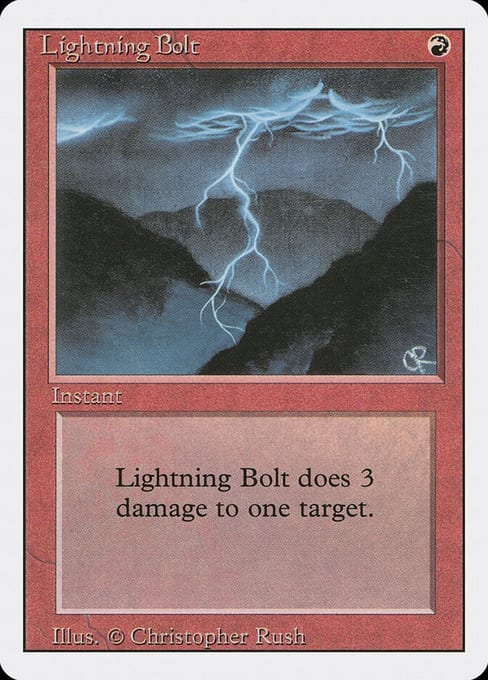
Revised Edition: white border, 1993 frame, no printed collector number. 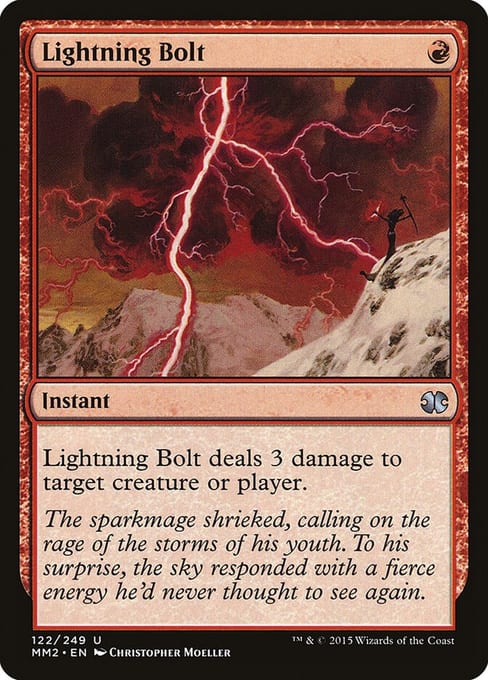
Modern Masters 2015, collector number 122: black border, 2015 frame, and no holofoil stamp because this printing is uncommon.
A card advertised as a foil also deserves a finish check. If the printing never shipped in foil, the listing and the card do not agree, regardless of how convincing the surface looks. These catalog images show printing identity. They do not authenticate a copy in an envelope.
A mismatch is a reason to investigate, not a final verdict. Some odd-looking cards are legitimate variations, and some counterfeits copy a printing closely enough that the physical inspection still matters.
Three problems that look alike
Separate these before you reach for a loupe.
- Condition describes wear on a genuine card. Scratches, whitening, edge wear, a crease, or a cloudy surface can make a card look poor without saying anything about its origin. Myth & Mint’s Magic card condition guide gives those defects their own inspection vocabulary.
- Printing variation describes real differences between authentic releases. Frame eras, border treatments, set symbols, language, and foil processes have changed over Magic’s history. A Collector’s Edition card with square corners and a gold border is not a counterfeit merely because it does not look like a black-bordered tournament printing.
- Counterfeiting is an unauthorized copy made to pass as a Wizards of the Coast product. That is the question this inspection is designed to answer.
A heavily played genuine card remains genuine. An unfamiliar frame can be legitimate. Conversely, one successful home test cannot certify a card. Keep those distinctions in view as you work.
Work through the physical checks
Use a known genuine card beside the suspect copy whenever you can. The comparison card should come from the same set or at least the same frame era. Look at both cards under the same light and in the same orientation.
1. Compare the whole card side by side
Check the dimensions, corners, border width, color balance, card-stock texture, and the sharpness of small text. A counterfeit that seems plausible alone may show a different blue in the card back, a slightly soft border, or a subtly different cut when placed next to a real card.
Do not compare a modern foil with a decades-old nonfoil and treat every difference as suspicious. The closer the reference is to the card’s claimed printing, the more useful the comparison becomes.
2. Feel the stock and check the weight
Put the two cards in your hands. A card that is noticeably lighter, thinner, flimsier, or waxier than its reference deserves another look. If you have a precise scale, weigh both cards under the same conditions and record the result for your own comparison.
Card stock has varied across printings, so a difference is evidence, not a verdict. Sleeves, humidity, surface treatments, and a poor comparison card can all muddy this check. Weight becomes useful when it agrees with other clues, not when it stands alone.
3. Inspect ink and fine detail
Use a loupe or a phone’s macro lens on the text, frame lines, set symbol, and small icons. Genuine print often keeps fine black edges clean and distinct. Counterfeits commonly show fuzzy text, ink bleeding into nearby colors, or a regular dot pattern where the original has a cleaner solid line.
Look at several parts of the card. One blurry photograph or one damaged patch does not tell you how the whole card was printed. A genuine card with surface wear can have a damaged-looking area, while a counterfeit can have a sharp-looking title and poor micro-detail elsewhere.
4. Check the back and front
Compare the color and letterforms of the word “Magic” at the top of the card back with your known genuine card. Look at the full back, not only the wordmark. Color balance, border sharpness, and the rosette around the center can all add context.
For rare and mythic rare cards from Magic 2015 onward, check the oval holofoil stamp at the bottom center of the card front. It should sit flush with the surface and carry a fine embedded pattern, not look like a raised sticker or a scratched decoration. The stamp is one signal among several, not proof on its own. The location matters: it is on the front of the card, not the back.
Siege Rhino from Khans of Tarkir uses the Magic 2015 frame, so the oval sits at bottom center on the front. Baneslayer Angel from Magic 2010 is a mythic without that stamp, which is expected: Magic 2010 predates the feature. A missing stamp on a rare or mythic rare printed before Magic 2015 is not a counterfeit signal. A missing stamp on a rare or mythic rare from Magic 2015 or any later set is a reason to keep inspecting, not a verdict from the photo. Neither image below authenticates a copy in hand.
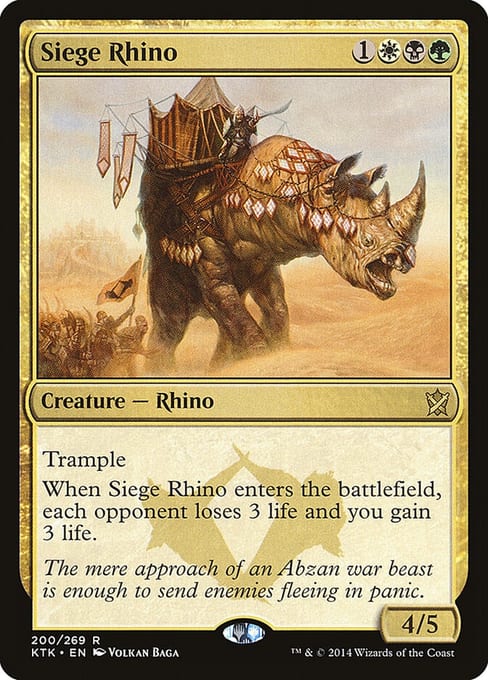
Khans of Tarkir rare: oval holofoil stamp at bottom center on the front. 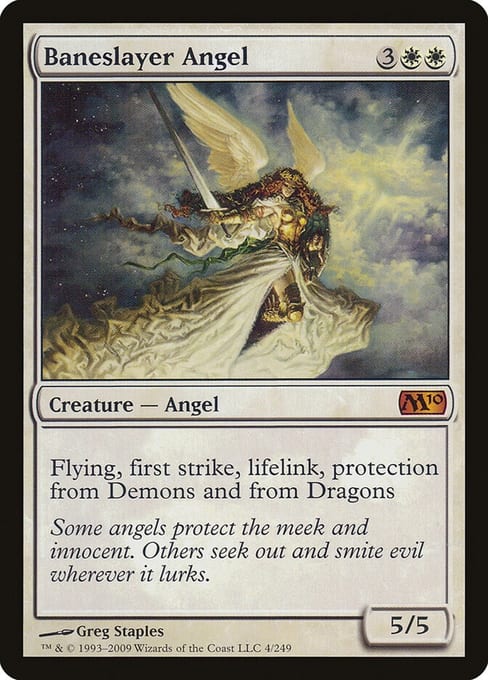
Magic 2010 mythic: no holofoil stamp, which matches a pre-Magic 2015 mythic.
5. Treat the light test as one clue
Holding a card over a bright light and looking at how evenly light passes through the stock is an old informal check, but printing stock has changed and some counterfeits can pass a casual light check.
An unusual result is worth adding to your notes. A normal result does not close the case. Never use a hot bulb, excessive heat, or anything that could mark the card while you perform this check.
6. Read the listing around the card
A price far below comparable copies is a prompt to slow down, not proof of a fake. Read the seller’s feedback, transaction history, description, stated printing, finish, language, and condition. Ask whether the image is of the actual copy or a stock image. The Myth & Mint marketplace-listing guide explains how those claims fit together.
A seller-taken photo can reveal a wrong set symbol or an undisclosed crease, but it cannot authenticate the card. The guide to photographing Magic cards for sale covers what a useful listing photo can show and where it stops.
Do not damage the card to test it
Some older counterfeit guides describe bending a card, tearing a corner to inspect its core, or wetting an edge to watch the ink. Those tests permanently damage the card. A genuine valuable card that fails because you damaged it is a worse outcome than an unanswered question.
A blacklight is not an official Magic security feature. Its inconsistent results are easy to mistake for a pass or fail, so it adds little useful evidence. Stick with the non-destructive checks above. If the card matters enough to authenticate, ask a local game store or experienced collector for a second opinion, or use a professional grading service that examines authenticity before assigning a grade.
If the evidence points to a counterfeit
Keep the card, packaging, listing screenshots, order information, and your comparison photos together. Do not return or destroy the card before the marketplace tells you what it needs.
For a TCGplayer purchase, TCGplayer’s Safeguard process (opens in a new tab), updated August 17, 2026, directs buyers who suspect a counterfeit to contact its dedicated customer-service chatbot right away with the relevant order details. TCGplayer provides a prepaid label and reviews the card at TCGplayer HQ instead of asking the buyer to make the final determination.
eBay’s counterfeit-item policy (opens in a new tab), reviewed August 29, 2026, treats counterfeit trading cards as prohibited items. Use eBay’s reporting and not-as-described process from the order rather than relying on a private message to the seller alone.
Wizards of the Coast’s counterfeit guidance (opens in a new tab), updated July 7, 2026, says that Wizards does not replace counterfeit cards or operate a card-verification service. It asks for information about where the card came from, such as the seller, contact details, listing, or store. If the card arrived through the mail and the transaction appears fraudulent, the United States Postal Inspection Service report channel (opens in a new tab) is the appropriate place to report suspected mail fraud. Mail fraud is not the only route. When the purchase never moved through the mail, such as a local pickup or a payment-app transfer, the FBI’s Internet Crime Complaint Center (opens in a new tab) and the Federal Trade Commission’s consumer fraud report form (opens in a new tab) both take online-purchase fraud complaints.
A practical inspection checklist
Before deciding that a card is fake, ask:
- Does the set code, collector number, frame, border, and finish match a real Scryfall printing?
- Did I compare it with a known genuine card from the same or a similar printing era?
- Do the weight and stock feel agree with the comparison card?
- Do fine black lines, text edges, and symbols remain clean under magnification?
- Does the card back match in color and letterforms?
- If it is a Magic 2015-or-newer rare or mythic, is the holofoil stamp on the front at bottom center and flush with the card?
- Does the light test add a concern, without treating a normal result as proof?
- Does the seller’s description, photograph, price, and reputation support the claimed card?
- Have I avoided bending, tearing, wetting, or otherwise damaging it?
- If the signals still conflict, have I asked someone experienced instead of guessing?
When the card still does not add up, preserve the evidence and use the marketplace or professional review process rather than trying to prove the case with damage.