
Set & card guides
Magic: The Gathering | Fallout: A Commander and Collector Guide
A collector's guide to Magic: The Gathering | Fallout, covering its four Commander decks, Collector Booster treatments, Rad counters, and product choices.
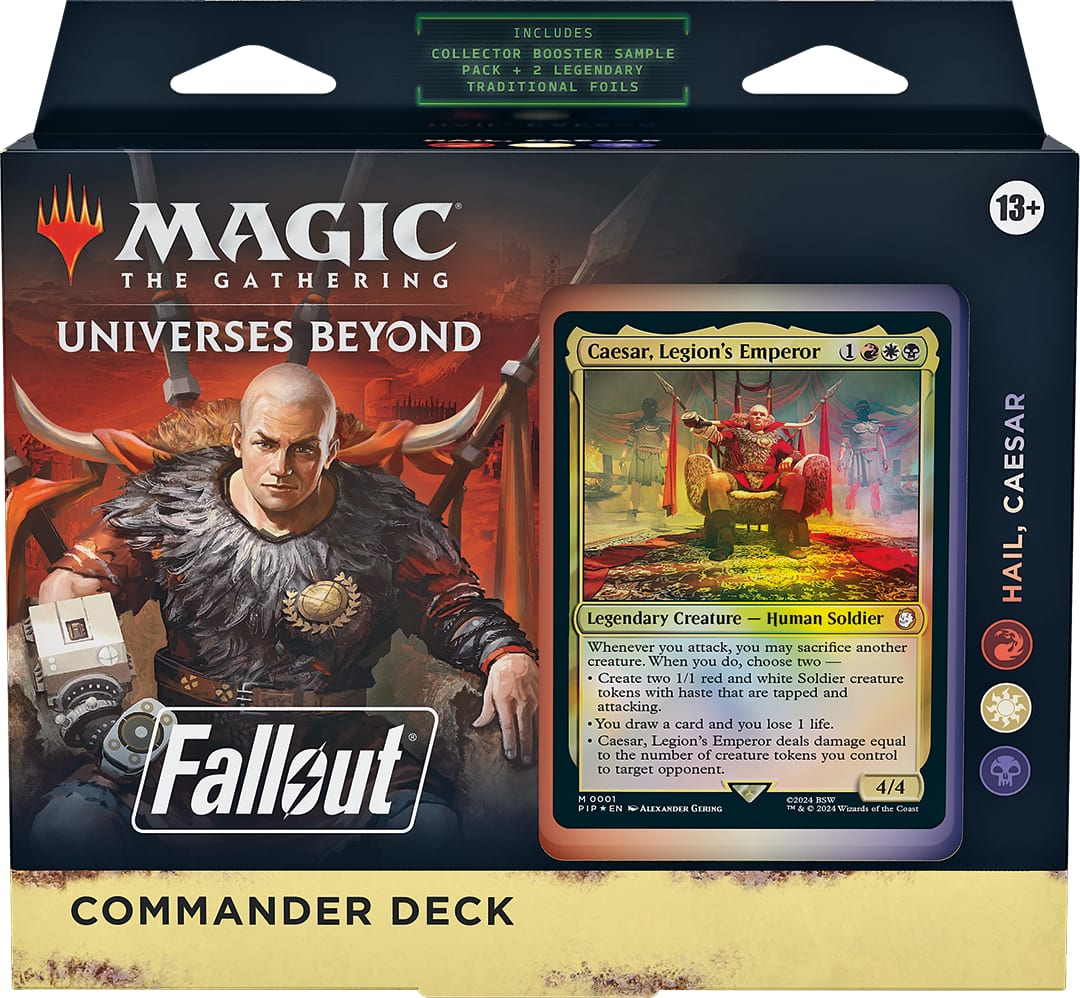
Magic: The Gathering | Fallout is a Commander release built around factions, radiation, and the objects people salvage after the world ends. Wizards of the Coast released it on March 8, 2024 with four preconstructed decks and Collector Boosters. There are no draftable booster packs in the line, so the first collecting decision is not which box to draft from. It is which wasteland story you want to play or display.
The official Fallout product page (opens in a new tab) divides the release into four complete decks and a premium booster product. The decks establish the faction game plans; Collector Boosters concentrate Pip-Boy frames, Vault Boy art, Surge Foils, and serialized Bobbleheads. Rad, Junk, Energy, and counter-based self-mill make the faction choice a mechanical decision before premium treatments enter the picture.
Four decks, four ways through the wasteland
Each preconstructed deck contains a complete 100-card Commander list, two traditional foil legendary commanders, a foil-etched display commander, ten double-sided tokens, a two-card Collector Booster Sample Pack, a deck box, and a life tracker. The new-to-Magic cards are delivered through the decks, so buying a deck is a direct way to get a playable faction rather than a gamble on opening one specific commander.
Scrappy Survivors: equipment, Auras, and Junk
Scrappy Survivors is Naya and is led by Dogmeat, Ever Loyal. It treats scavenging as a board-building plan: Equipment and Auras make creatures useful attackers, while Junk tokens turn spare artifacts into access to more cards. Dogmeat’s graveyard interaction and attack trigger reward a deck that keeps its equipment moving instead of leaving one creature suited up forever.
Preston Garvey, Minuteman offers a different angle within the same deck. At the beginning of combat he creates a Settlement Aura, whose enchanted land gains a mana ability. When Preston attacks, he untaps each enchanted permanent you control. That means the Aura is both fixing and a permanent worth building around, while the attack trigger rewards committing Preston to combat.
Science!: Energy and artifact sequencing
Science! is Jeskai and puts Dr. Madison Li at the front of an artifact engine. Her energy trigger happens when her controller casts an artifact spell, not whenever any player casts one. Her five-energy ability can return any artifact card from the graveyard, including a noncreature artifact. The deck therefore wants a steady stream of artifact spells and choices about when to save energy for a meaningful return.
Liberty Prime, Recharged is the deck’s large machine, but the point of Science! is not simply to cast the biggest artifact. It is to turn energy into momentum, then choose between haste, cards, and recursion as the battlefield changes.
Hail, Caesar: sacrifice and attack triggers
Hail, Caesar is Mardu and uses Caesar, Legion’s Emperor to make combat do more than deal damage. Whenever you attack, you may sacrifice another creature, even if Caesar remains untapped and out of combat. If you do, you choose two of the deck’s modes, which can create tapped and attacking Soldiers, draw a card while losing life, or damage one target opponent. Small creatures and disposable tokens become a menu of attack-time decisions.
Mr. House, President and CEO takes the same deck in a more random direction. His own activated ability rolls six-sided dice, while any die result of 4 or higher creates a Robot and a result of 6 or higher also creates a Treasure. A d20 roll of 10 creates a Robot, so other dice-rolling cards can feed the same reward trigger.
Mutant Menace: mill, Rad, and counters
Mutant Menace is Sultai and is led by The Wise Mothman. The deck turns milling into a resource, then spreads +1/+1 counters across a growing board. When one or more nonland cards are milled, The Wise Mothman may put a counter on each of up to X target creatures, where X is the number of nonland cards milled that way. Those targets can include an opponent’s creatures, so the trigger is flexible rather than an automatic team pump.
The Master, Transcendent gives the same graveyard plan a different destination. Its activated ability can return a creature card from any graveyard, but only when that creature was milled that turn. The timing requirement rewards a deck that can mill and use the graveyard in the same turn instead of treating every creature in every graveyard as available.
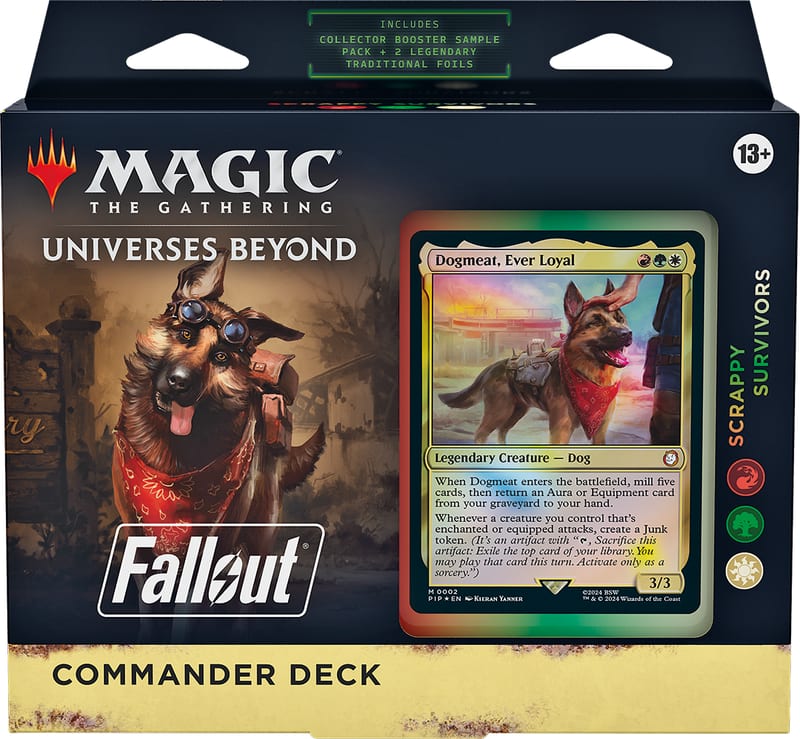
Scrappy Survivors Commander DeckOfficial product image via Wizards of the Coast (opens in a new tab) 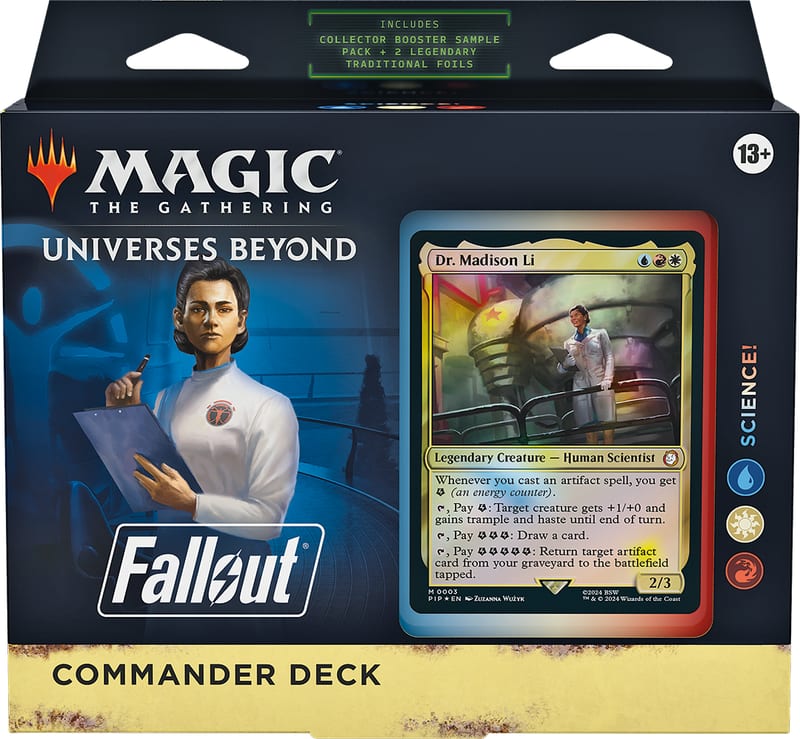
Science! Commander DeckOfficial product image via Wizards of the Coast (opens in a new tab) 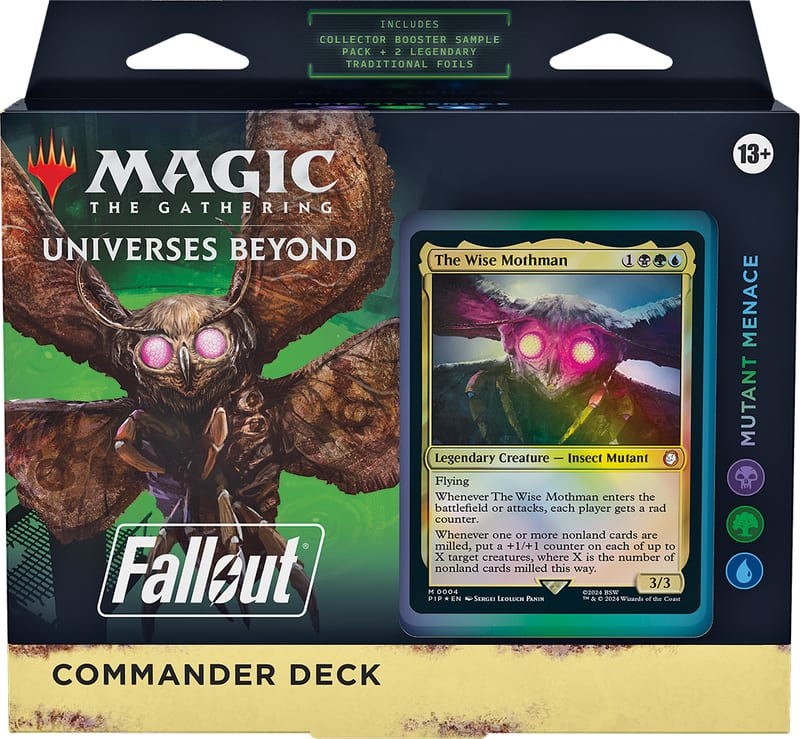
Mutant Menace Commander DeckOfficial product image via Wizards of the Coast (opens in a new tab) 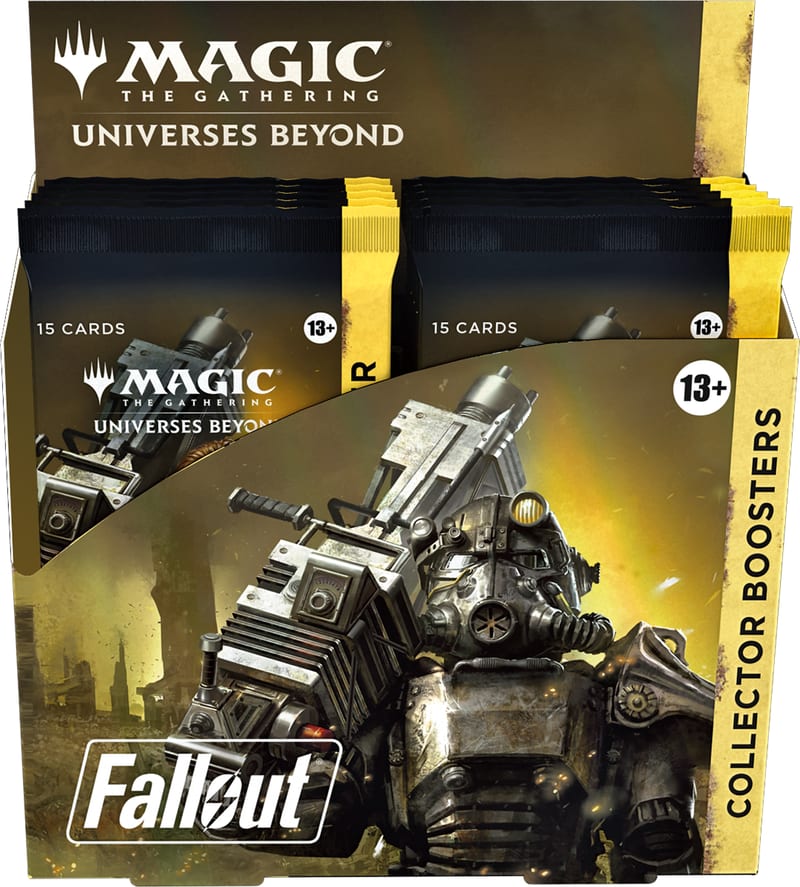
Fallout Collector Booster DisplayOfficial product image via Wizards of the Coast (opens in a new tab)
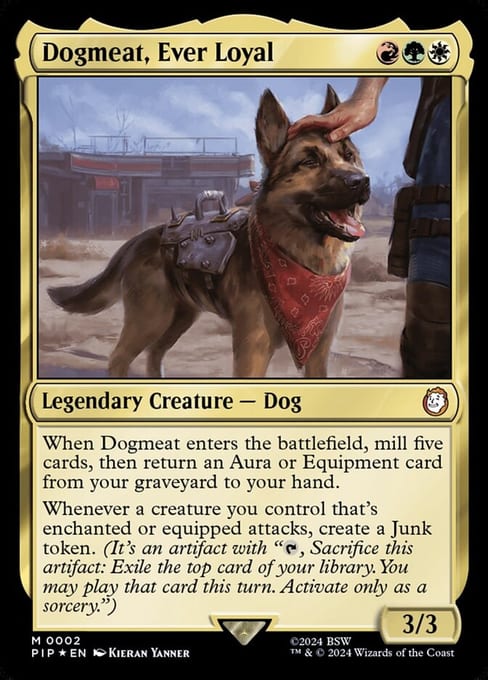
Keeps Equipment moving instead of parking it on one body. 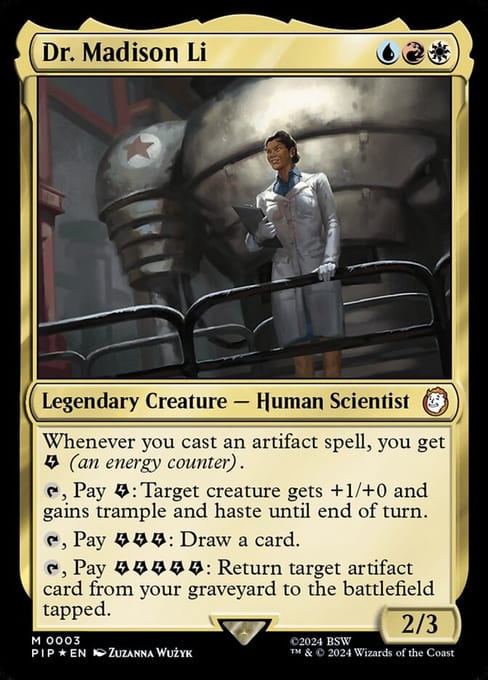
Energy from your artifact spells, saved for a later graveyard return. 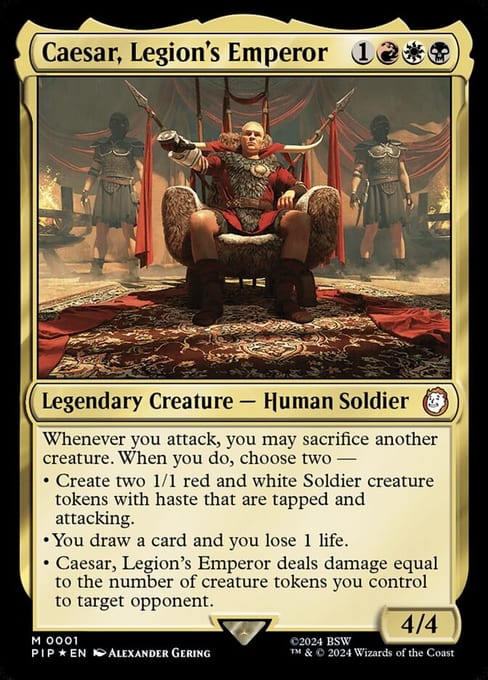
Sacrifice another creature when you attack, then choose two modes. 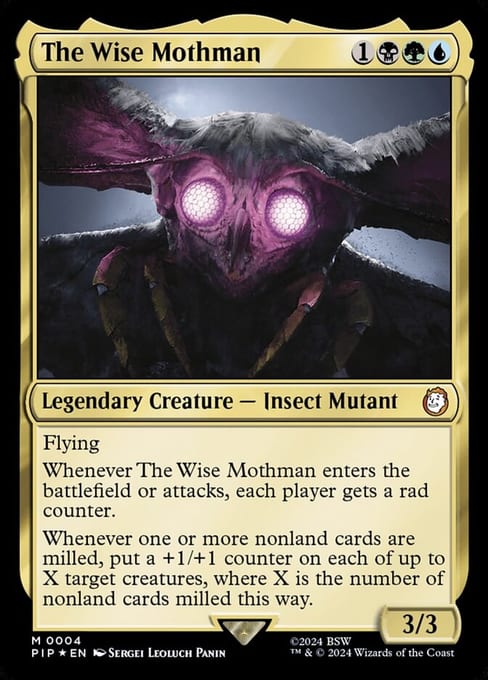
Mills become counters you can place, including on an opponent's creature.
What is in a Collector Booster?
Collector Boosters are the only booster product in the Fallout release. Each contains 15 cards, and displays hold 12 packs. The Fallout collecting guide (opens in a new tab) describes the product as a treatment-focused supplement to the decks, with foil cards, Pip-Boy showcase cards, Vault Boy borderless cards, Surge Foils, and a chance at serialized Bobbleheads.
The Pip-Boy treatment uses the green terminal look associated with the games. The Vault Boy cards go in a different direction, using the franchise mascot to turn Magic cards into illustrated propaganda posters. Those are not interchangeable collecting lanes. A binder organized by Pip-Boy frames looks very different from one organized by Vault Boy art.
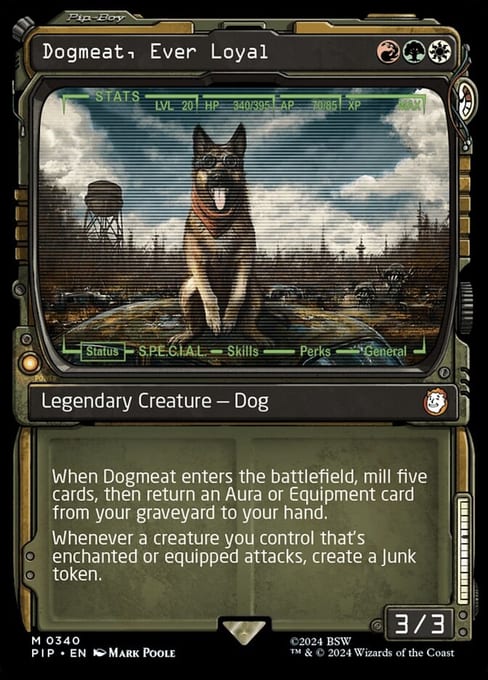
The green terminal frame is a Collector Booster lane, not the deck printing. 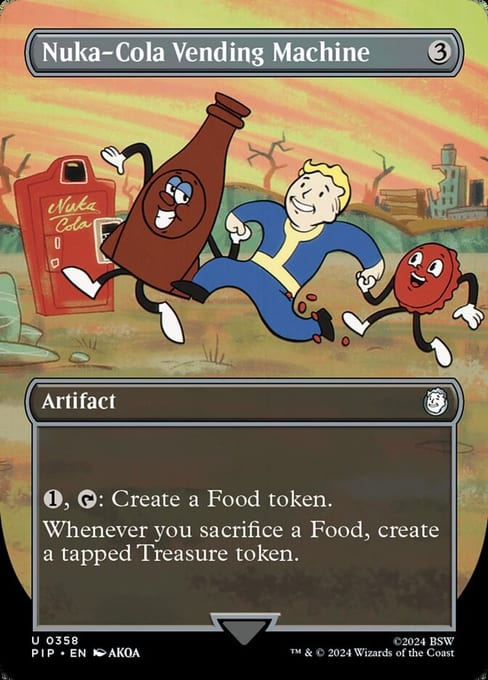
Vault Boy art is a separate visual collection from Pip-Boy.
Seven SPECIAL Bobblehead artifact cards have serialized versions: Strength, Perception, Endurance, Charisma, Intelligence, Agility, and Luck. Each is numbered out of 500. Treat them as a separate display project from completing the four Commander decks. A Collector Booster is a way to hunt for treatments, not a required purchase for a playable Fallout collection.
The original Secret Lair companion drops also deserve their own checklist. Vault Boy, Points of Interest, and S.P.E.C.I.A.L. extend the setting with cards outside the four decks and Collector Booster pool. Keeping those releases separate prevents a themed Secret Lair card from being mistaken for a missing PIP card.
The January 2026 Rad Superdrop (opens in a new tab) is a distinct later collecting lane. Its four drops are Beyond Vault 33, Greet the Dog, Rad, and Welcome to New Vegas. Beyond Vault 33 adds three new-to-Magic designs, while the other drops revisit existing cards through Fallout characters and art. Track this wave separately from both the original companion drops and the PIP card pool.
The mechanics that carry the setting
The official mechanics article (opens in a new tab) explains the rules. Their collecting value comes from how clearly each one identifies a faction or a decision.
Rad counters create a shrinking clock
At the beginning of a player’s precombat main phase, that player mills a number of cards equal to their Rad counters. For each nonland card milled this way, they lose a life and remove one Rad counter. Rad counters therefore threaten life total and feed a graveyard at the same time, but they also run down when the cards are nonlands. That makes Rad a pressure tool with a changing clock rather than a simple poison counter.
The Wise Mothman wants those mills to happen. A creature deck facing it has to consider not only the life loss but also the counters that the resulting nonland cards can distribute.
Junk tokens trade an artifact for a card opportunity
A Junk token is a colorless artifact with a tap-and-sacrifice ability you may activate only as a sorcery. It exiles the top card of your library and lets you play it that turn under its normal timing rules, as the official Fallout release notes (opens in a new tab) clarify; an instant exiled during your main phase can still be cast later that turn. The token is not a Treasure and cannot simply become mana. It is a delayed, one-turn card selection effect, which suits a scavenger deck that wants to keep finding lands or action after its battlefield is established.
Energy is saved for later turns
Energy counters return from Kaladesh as a resource that remains with the player. Unlike unspent mana, energy does not empty between phases or turns. Science! can therefore spend one turn building a reserve and a later turn converting that reserve into a large artifact or a burst of cards. The useful question is not just how much energy a card makes, but what the deck wants to save it for.
Squad scales a creature by its printed squad cost
Squad lets you pay a card’s stated squad cost any number of times as an additional cost. When the creature enters, you create that many token copies. The cost is printed per card, so this is not a generic X cost that can be chosen freely. Fallout uses Squad on cards such as Gary Clone and Securitron Squadron to let a late draw become several bodies when the mana and board position support it.
Cards that show the deck decisions
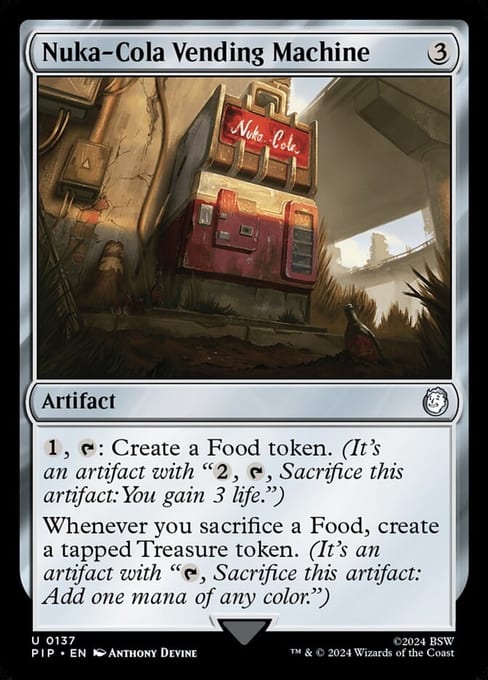
Nuka-Cola Vending Machine is a good example of Fallout’s artifact economy. Its activation turns mana into Food, and sacrificing that Food later creates a tapped Treasure. The machine asks you to decide when to spend mana to create Food and when the delayed Treasure is worth preserving, rather than handing out free resources.
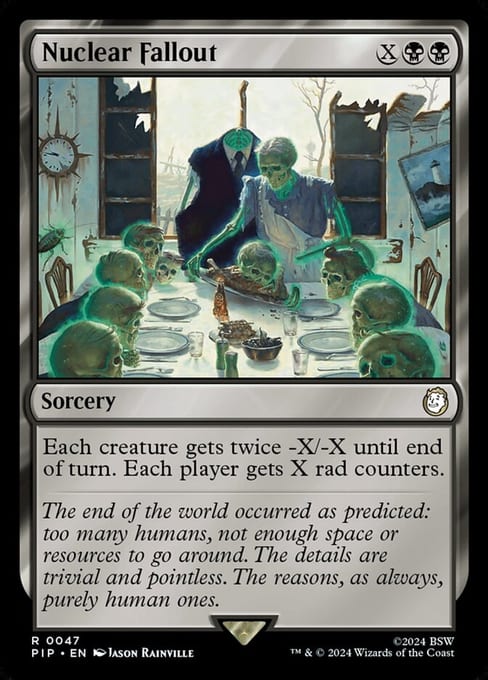
Nuclear Fallout combines two clocks. It gives each creature -X/-X twice, which means X=3 produces -6/-6, and it gives players X Rad counters. The spell can clear a board while setting up the next radiation trigger, so the card belongs in a deck that benefits from the graveyards it creates or can survive the fallout.
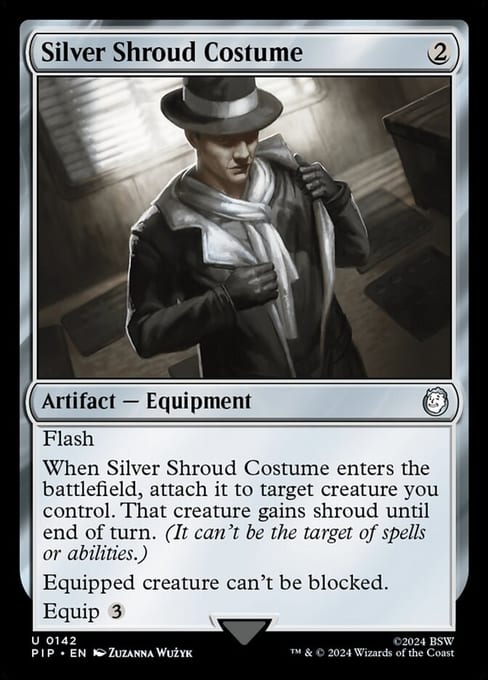
Silver Shroud Costume shows the value of reading an Equipment’s two moments separately. Under the official Fallout release notes (opens in a new tab), its enters-the-battlefield ability targets a creature you control, so an opponent can respond before that trigger resolves. Once it resolves, the Costume attaches and that creature gains shroud until end of turn; the shroud protects the creature, not the Costume. Its lasting equipment ability makes the equipped creature unblockable.
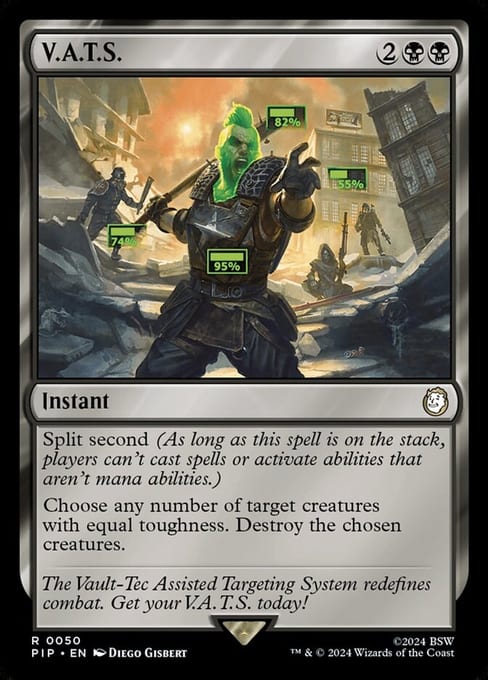
V.A.T.S. is a narrower answer than a generic sweeper because it chooses creatures with equal toughness. That restriction becomes a deck-building consideration: the card is at its best when the table has a clear cluster of matching bodies, and it asks you to notice toughness rather than creature type.
A practical buying route
- Choose the deck before choosing a treatment. Equipment and Junk, Energy artifacts, sacrifice attacks, and mill plus counters are separate play patterns. The face commander is a better first filter than a favorite piece of art.
- Buy the deck for new cards and immediate play. A preconstructed deck gives the complete 100-card experience. A Collector Booster adds variants and selected reprints, not a second deck.
- Pick one visual lane if you are building a binder. Pip-Boy, Vault Boy, Surge Foil, and serialized Bobbleheads tell different stories. Organize around the treatment you want to see rather than treating every finish as one checklist.
- Keep Secret Lair waves separate. The three original companion drops and the four-drop Rad Superdrop are part of Fallout’s wider product history, not missing cards from the four precons.
- Check legality by card name, not the PIP set code alone. A PIP printing follows the format legality of that card name: Farewell, for example, is legal in Modern and Pioneer, while new-to-Magic PIP cards are not automatically legal there.
For opened decks, count the full list, tokens, and display pieces before treating the box as complete. For foil cards, inspect dark borders and surfaces under good light. Our Magic Card Condition Guide explains the general checks, while How to Read an MTG Marketplace Listing covers the photographs and printing details a useful listing should provide.