
Set & card guides
Understanding MTG Reprints: Bonus Sheets, Special Guests, and The List
A practical guide to Magic: The Gathering reprints, bonus sheets, Special Guests, The List, promos, and mechanically distinct crossover cards.
A card from a Magic booster does not always belong to the set printed on the wrapper. It might be a normal reprint in the main set, a card from a themed bonus sheet, a Special Guest with new art, or a List card retaining details from an older printing. Those categories look similar in a binder but lead to different answers about the card’s origin, Limited use, and format legality.
The quickest way to sort them is to identify the printing first. Read the set code and collector number, then compare the card’s art, frame, symbol, and any stamp with the release guide. Scryfall’s card-object documentation (opens in a new tab) is useful for the structured fields, but the set’s own collecting article explains how that product distributed the card.
Ordinary reprints are members of the main set
An ordinary reprint takes a normal slot in the main set and uses that set’s code, symbol, and collector-number sequence. It can have new art, old art, or a treatment such as borderless. Its defining feature is membership in the main set, not whether the art is familiar.
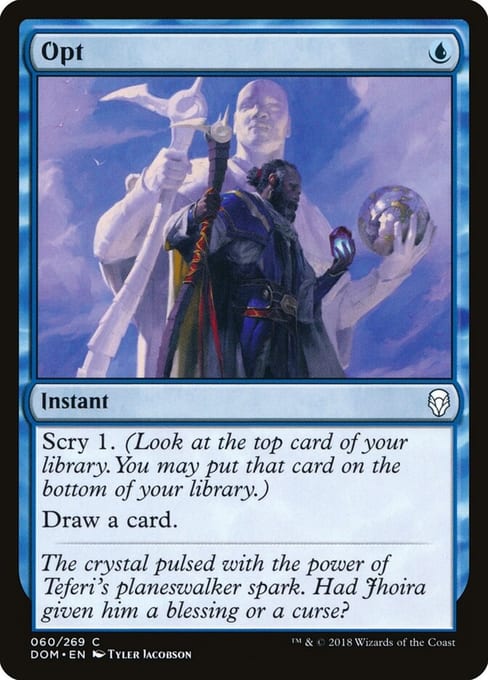
Opt in Dominaria is a straightforward example. It is a Dominaria card, not a separate Opt-only insert. A reprint in a Standard-legal premier set can make that printing legal in Standard. A reprint in a supplemental set such as Modern Horizons 3 follows that set’s format permissions instead. Check the current legality record for the specific card and format rather than treating the word “reprint” as a legality label.
Bonus sheets add a named subset
A bonus sheet is a curated group of reprints that sits alongside the main set. Its cards use their own set code, symbol, and collector-number sequence. The name tells you the cards were curated for that release; it does not make them main-set cards.
Recent examples show how much the themes can change:
- Mystical Archive collected instants and sorceries for Strixhaven.
- Retro Artifacts brought classic-frame artifacts to The Brothers’ War.
- Multiverse Legends collected legendary creatures for March of the Machine.
- Enchanting Tales gathered enchantments for Wilds of Eldraine.
- Breaking News used crime-related cards for Outlaws of Thunder Junction.
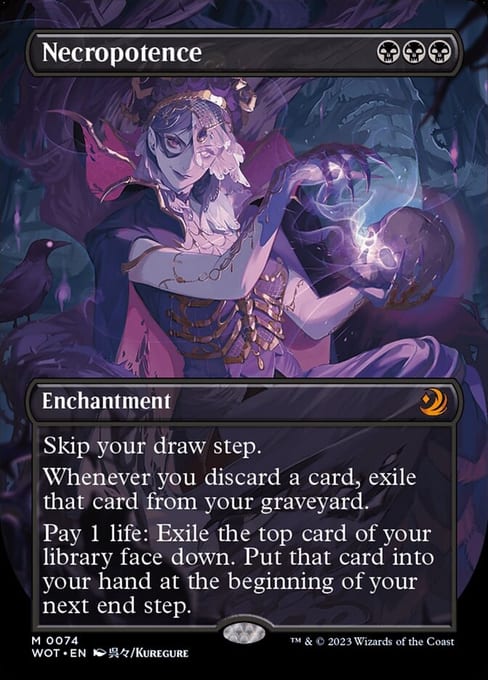
Bonus-sheet cards can enter a Draft or Sealed pool when the release puts them in that Limited product. Their inclusion does not rewrite constructed legality. Necropotence in Wilds of Eldraine’s Enchanting Tales is the useful caution: the printing did not make it Standard or Pioneer legal, and the card is currently banned in Legacy. Scryfall’s Necropotence record (opens in a new tab) is the place to check its current format list.
The List kept the original printing identity
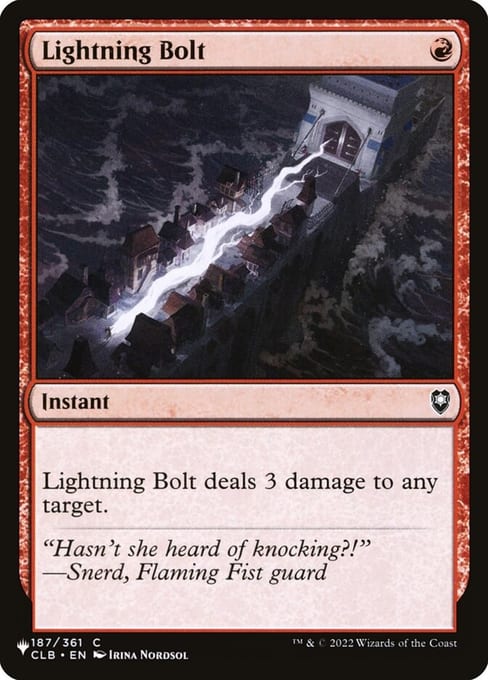
The List began as a curated roster that could appear in Set Boosters. Unlike a bonus-sheet card, a List card generally retained the set symbol, set code, collector number, and art of the original printing. In releases that used the program, a small white planeswalker symbol on the card distinguished the List copy.
That small mark is why The List was easy to miss. The code on the card pointed to the older printing, not to a new List subset, even though databases give the List copy its own record: Scryfall files this Lightning Bolt under set plst at collector number CLB-187 while the card itself prints 187/361 C over CLB • EN. Its roster and slot changed over time, especially as Play Boosters replaced Set Boosters. The Play Booster era has also used smaller curated selections, Special Guests, bonus sheets, or none of these depending on the release.
A List card opened in Limited can be used in that Limited pool when the release’s rules allow it. It does not become legal in a constructed format merely because it came out of a current booster. Read the release’s collecting guide for the slot and the card’s current legality separately.
Special Guests are new-art reprints with a distinct identifier
Special Guests are reprints with new artwork shaped around the plane or theme of the release. They use the SPG identifier and a shared Special Guests symbol rather than the original card’s expansion symbol. Because SPG is reused across releases, pair it with the collector number and the release context when cataloging one.
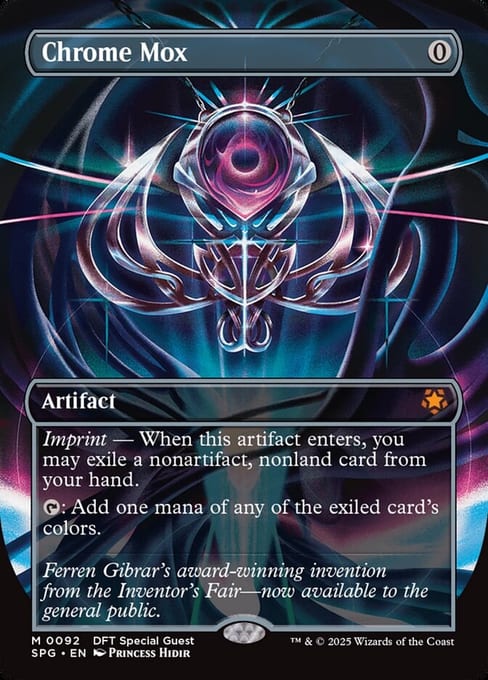
The distribution detail is the part most likely to be misstated. In the Murders at Karlov Manor Play Booster model, a Play Booster can contain either a Special Guest or a card from The List in place of the seventh common. The two are alternatives to each other, and each one takes a common’s place. It is not a guaranteed extra card in a dedicated slot. The Murders at Karlov Manor collecting guide (opens in a new tab) explains that replacement model and the release’s other card slots.
Special Guests can also appear in Collector Boosters, but finish and odds vary by release. Their reprint identity does not change the underlying card’s constructed legality. They can be used in Limited when opened into that pool, subject to the release’s rules.
Promos and Secret Lair reprints use different channels
Promos are defined by distribution or marking, not by a single visual frame. Prerelease, Store Championship, Friday Night Magic, Buy-a-Box, and Judge Promos can all look different and can use different codes or collector-number patterns. A Prerelease promo can retain the main-set symbol, so a distinct symbol is not a requirement. Check the stamp, promo field, collector number, and release guide together.
Secret Lair drops are another route for reprints. Most drops use limited print runs, with print-to-demand ordering retained as an exception. Their SLD cards often give familiar cards new art and a dedicated product identity. A Secret Lair reprint does not change the card’s format legality. That sentence applies to the reprint, not to every card ever sold through Secret Lair: mechanically unique cards also exist, so check the individual card’s legality before an event.
Reskins and mechanically distinct cards are not ordinary reprints
Some crossover cards display a licensed name prominently while carrying an underlying Magic card name. The Godzilla cards from Ikoria established the pattern. “Godzilla, King of the Monsters” is the character-facing name for Zilortha, Strength Incarnate, which appears beneath it. For deck construction and rules, the underlying Magic name is the identity that matters. Dracula cards from Innistrad: Crimson Vow use the same kind of reskin logic.
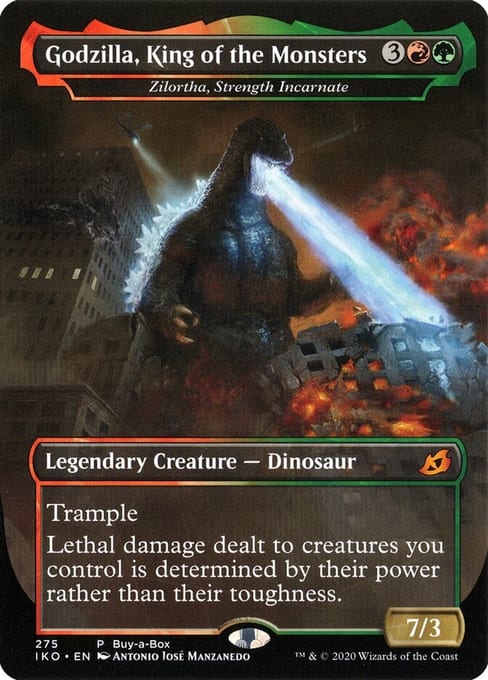
That is different from a crossover collection built from mechanically new designs. Jurassic World cards are not all Godzilla-style alternate names for existing cards; the collection includes mechanically distinct designs. Do not infer a shared card identity from the license or art style alone. Read the card’s printed names and the release notes.
Universes Within is a third case. Wizards used it to give normal Magic names and settings to mechanically unique cards that first appeared in the Stranger Things Secret Lair. Eleven, the Mage and Cecily, Haunted Mage are a matched example. They have different names and art but share the same mechanical identity for the rules that treat the pair as one card. The Magic comprehensive rules (opens in a new tab) and the specific card record settle how a pair works; do not assume that every crossover card has a Universes Within counterpart.
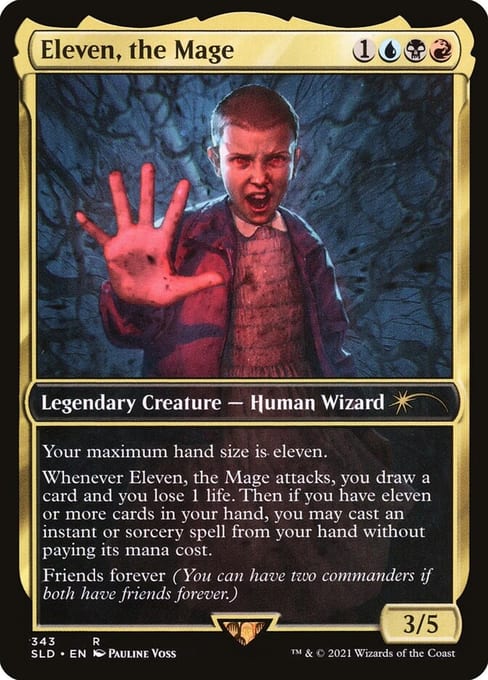
The Secret Lair printing carries the licensed name Eleven, the Mage. 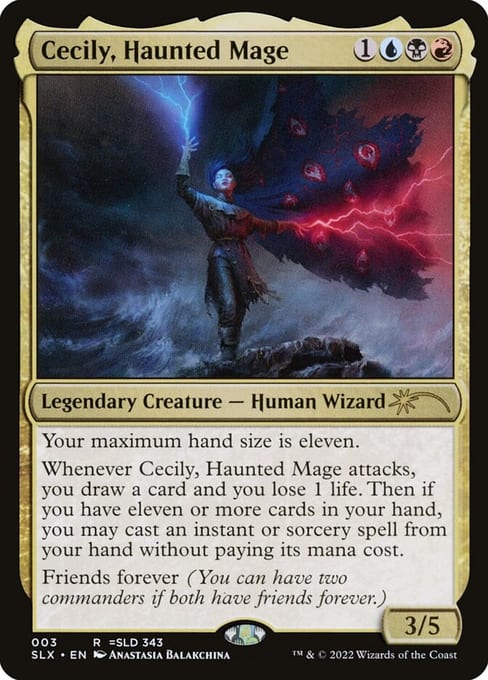
The Universes Within printing uses Cecily, Haunted Mage. Same mechanical identity, different names and art.
Identify the card before checking legality
When a card comes out of a pack, use this order:
- Read the collector number, rarity mark, and set code.
- Decide whether the code points to the main set, a bonus sheet, Special Guests, or the original printing of a List card.
- Compare the expansion symbol, art, frame, border, stamp, and any serial mark.
- Search the exact printing in a card database.
- Check the current legality of that card in the format you plan to play.
An OTJ wanted-poster card is a Booster Fun variant from the main set and keeps OTJ. BIG identifies The Big Score, a separate subset that was Standard legal with Outlaws of Thunder Junction. Those examples show why the wrapper’s set name and the printed code are not enough on their own. Identify the subset, then verify legality. Never derive either fact solely from whether a code matches the wrapper’s main set.
The same check helps at a trade table. A bonus-sheet card, a List card, and an ordinary reprint can share a name while representing different physical printings. The guide to reading an MTG marketplace listing covers how to carry that identity check into a purchase.
The useful question is not simply “is this a reprint?” Ask which reprint channel produced it, which printing is in your hand, and what the current format record says. Once those are separate, the symbols and codes stop being decoration and start doing their job.