
Curated recommendations
How to Upgrade a Commander Precon: Seven Concrete Steps
Upgrade a Commander precon through seven repeatable steps, with a complete ten-card Wakanda Forever swap ledger, mana-curve changes, and exact costs.
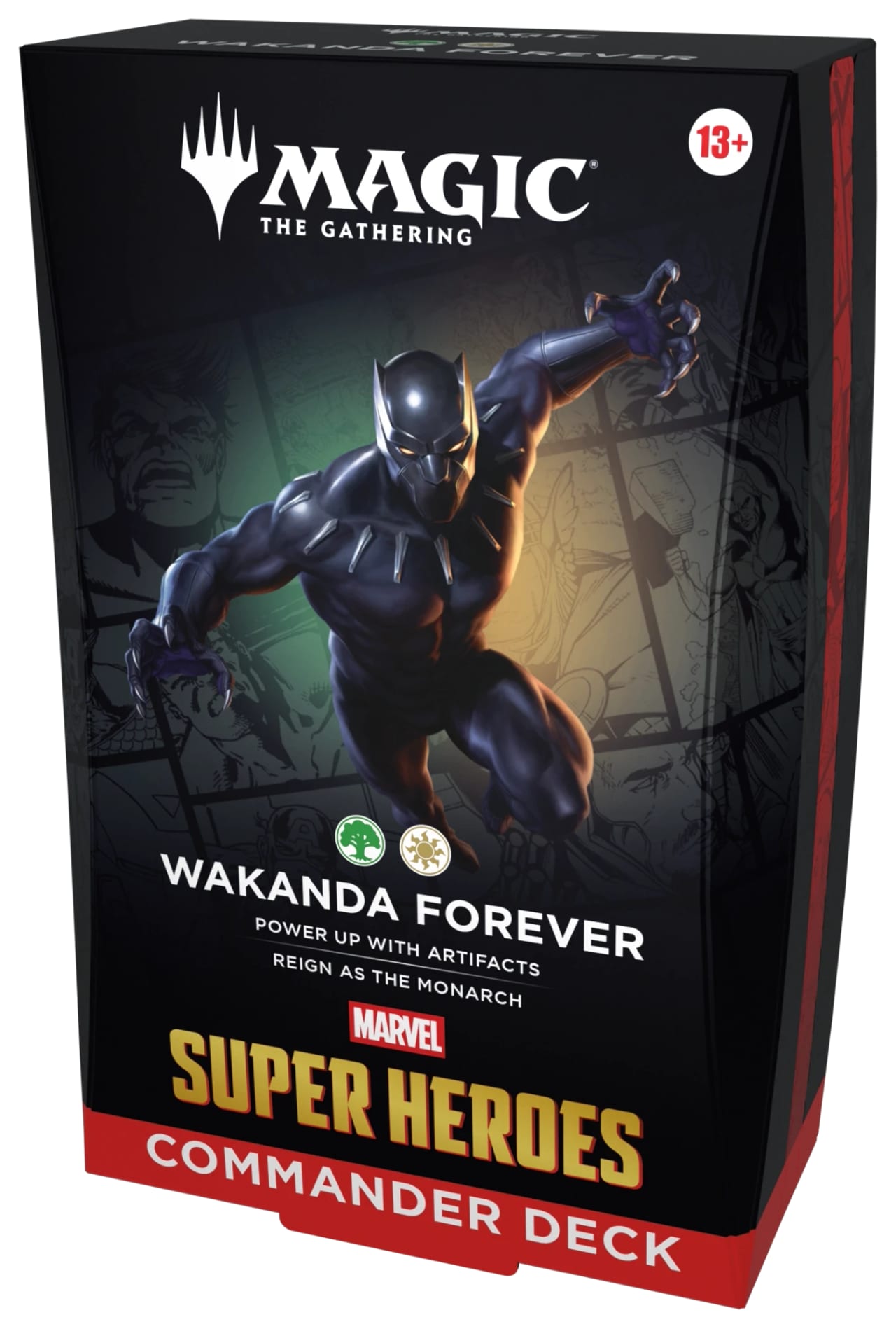
A good preconstructed Commander deck is already playable. The safest upgrade is not “replace every inexpensive card.” It is a measured pass: define what the commander wants, inventory the stock list, identify one bottleneck, make exact one-for-one swaps, then compare the result with the original.
This guide demonstrates the method on Wakanda Forever, the green-white Magic: The Gathering | Marvel Super Heroes Commander deck led by T’Challa, the Black Panther. Wizards published the official 100-card list and product details (opens in a new tab) on June 11, 2026, ahead of its June 26 release. The worked pass below changes exactly ten cards, keeps all 38 lands, and leaves a legal 100-card deck.
Step 1: read the commander as a plan
Read the commander before reading upgrade lists. Write one sentence that describes what your deck is trying to do. If you cannot describe the plan, you cannot judge whether a card serves it.
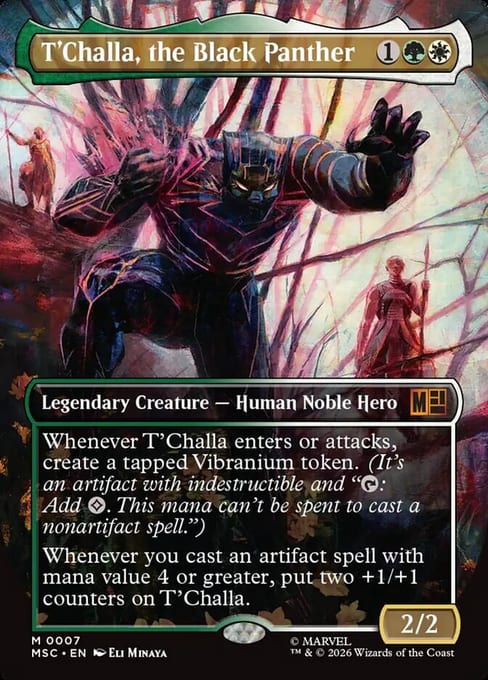
T’Challa costs . When it enters or attacks, it creates a tapped Vibranium artifact token. That token makes colorless mana that cannot be spent to cast a nonartifact spell, but it can still pay non-spell costs such as equip costs and activated abilities. Each artifact spell with mana value 4 or greater then puts two +1/+1 counters on T’Challa.
The stock deck’s plan can therefore be stated precisely:
Attack with T’Challa to produce Vibranium, spend that restricted mana on substantial artifacts, and convert those casts into commander damage while artifact and Soldier tokens provide the wider board.
That sentence establishes the test for this pass. An addition should improve early artifact development, turn recurring token production into card flow, protect the artifact board, or provide a qualifying artifact payoff. A generally strong card that does none of those things is a lower priority.
Step 2: inventory the stock 100 before cutting
Do not tune from memory. Count the published deck exactly as it exists. The official Wakanda Forever list has 78 distinct entries and reaches 100 cards after its basic-land quantities are expanded.
| Inventory measure | Stock count |
|---|---|
| Total cards, including commander | 100 |
| Lands | 38 |
| Basic lands | 24 |
| Nonbasic lands | 14 |
| Nonland cards, including commander | 62 |
| Artifact spells | 28 |
| Nonartifact creature spells | 20 |
| Other nonland spells | 14 |
| Nonlands with mana value 1-3 | 26 |
| Nonlands with mana value 4-5 | 29 |
| Nonlands with mana value 6 or greater | 7 |
| Artifact spells with mana value 4 or greater | 23 |
The deck already has a real artifact core: 23 spells can trigger T’Challa’s counter ability. The weakness selected for this pass is narrower. The middle of the curve is crowded, several draw effects ask for extra mana or expose a valuable permanent, and some early nonartifact cards neither use Vibranium nor increase artifact density.
That diagnosis prevents random churn. This is not a claim that every removed card is bad. It is a choice to exchange ten flexible slots for cheaper artifact setup, token-compatible draw, and artifact payoffs while preserving the land count and the seven-card top end.
Step 3: audit mana before exciting cards
Before adding finishers, verify the deck can cast spells on schedule.
- Count lands. Start near 36-38 unless the commander’s curve and reliable acceleration justify moving.
- Count early mana. Two-mana rocks and land-ramp spells matter more than splashy five-mana acceleration because they change what you can do on turn three.
- Count colored sources, not just lands. A land that produces only colorless mana does not help cast a double-pipped spell.
- Separate reducers from mana sources. A reducer can make a class of spells cheaper, but it cannot pay an activated ability or another spell.
- Test opening hands. Goldfish at least ten hands and record the turn on which each hand produces every required color.
The stock list already includes two familiar one- and two-mana artifacts. Sol Ring accelerates colorless costs; Arcane Signet taps for a color in the commander’s color identity. In this green-white deck, that means green or white, never colorless as a third color.
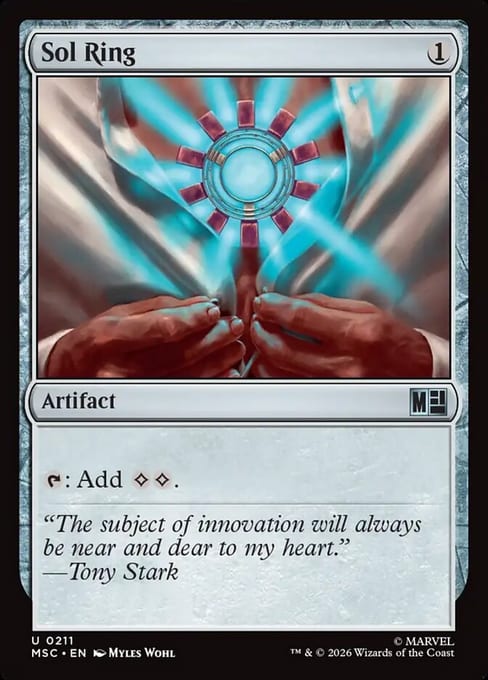
Sol Ring supplies fast colorless mana. 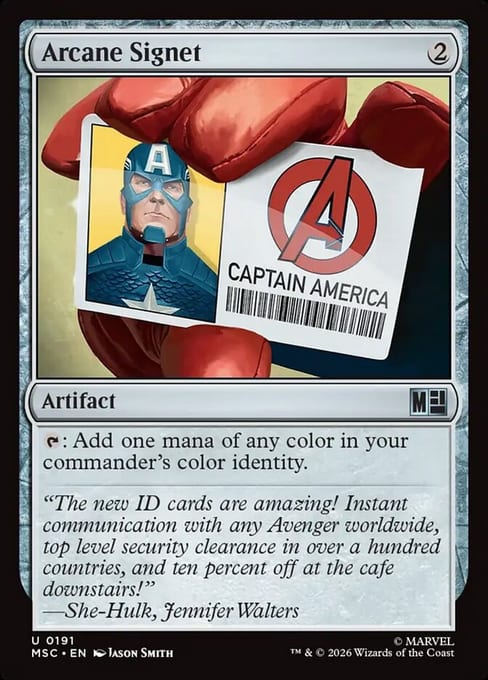
Arcane Signet fixes within T'Challa’s green-white identity.
Land-search spells need equally literal reading. Nature’s Lore finds a Forest card and puts it directly onto the battlefield, so an eligible dual can enter untapped if that land’s own text allows it. Farseek can find a Plains, Island, Swamp, or Mountain card, but the found land enters tapped. Cultivate finds two basic lands, putting one onto the battlefield tapped and the other into hand.
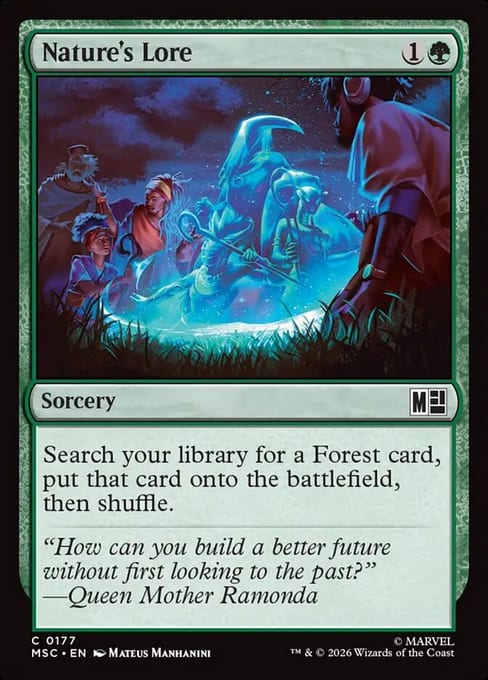
Nature’s Lore can find a land with the Forest type. 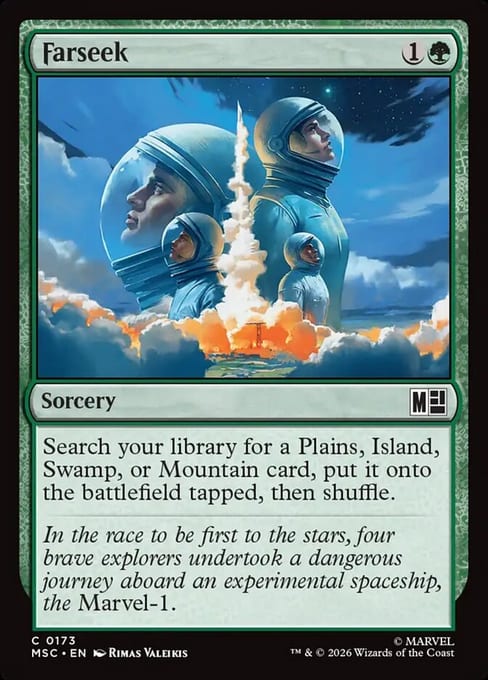
Farseek broadens land types but always puts its find in tapped. 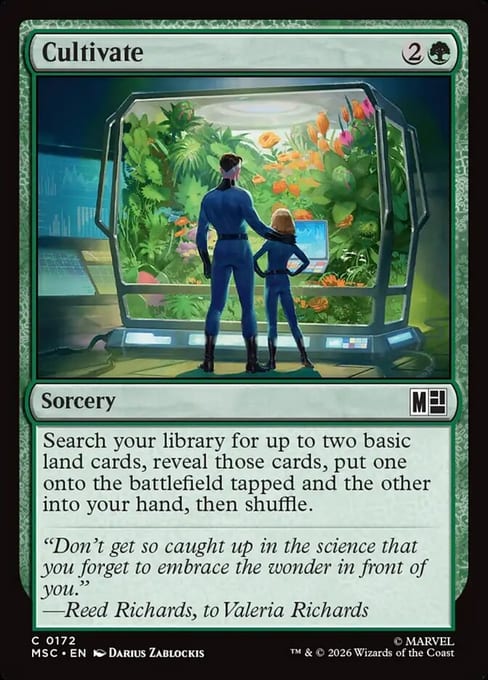
Cultivate develops the battlefield and the next land drop.
For this worked pass, 38 lands remain untouched. The mana change is one-for-one: a fragile one-mana creature source becomes a two-mana artifact source, and a three-mana nonartifact creature becomes a three-mana artifact cost reducer. The reducer is recorded separately; it is not counted as another land or mana source.
Step 4: audit card flow and interaction
A Commander deck needs ways to see more cards. Do not count only cards containing the word “draw.” Count repeatable top-of-library access, impulse access, recursion that reliably returns usable cards, and commanders that replace spent resources. Keep those categories separate in your worksheet so optimistic labels do not hide a shortage.
For the T’Challa list, the important question is not “does the deck draw at all?” It does. The question is whether draw can be moved earlier and attached to actions the deck already takes: creating tokens and casting artifacts. Four swaps below turn one-shot or mana-hungry stock draw slots into cheaper repeatable artifact engines.
Interaction needs the same precision. Swords to Plowshares exiles a creature, but it cannot answer a noncreature artifact, enchantment, battle, or planeswalker. Broad effects such as Beast Within and Generous Gift cover noncreature permanent types, though each gives that permanent’s controller a 3/3 token.
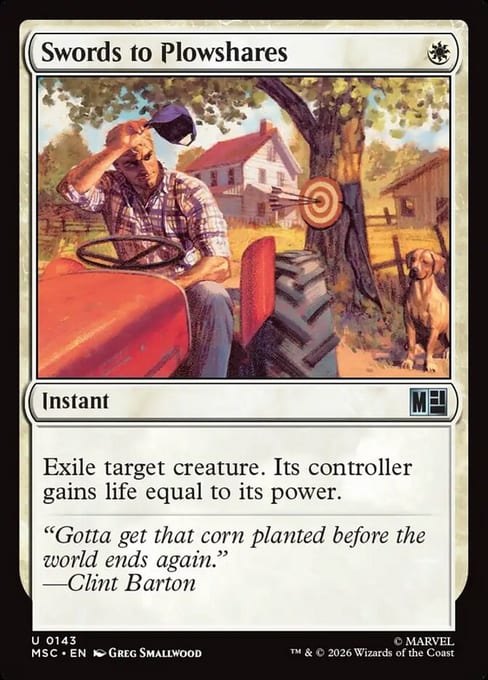
Efficient creature exile, not universal permanent removal. 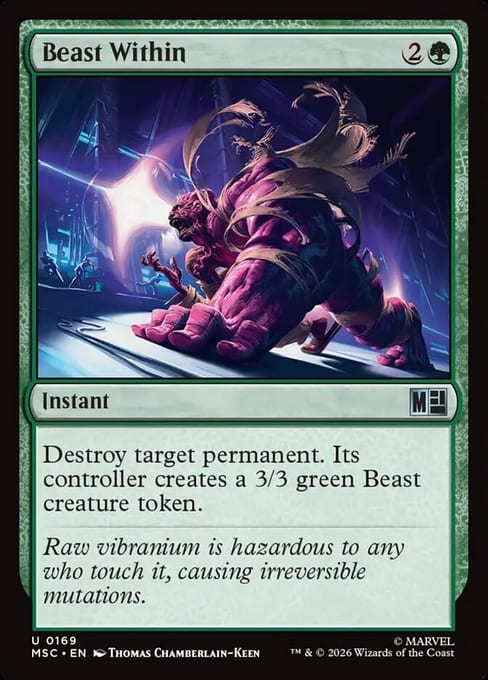
Broad permanent removal with a 3/3 token given in return. 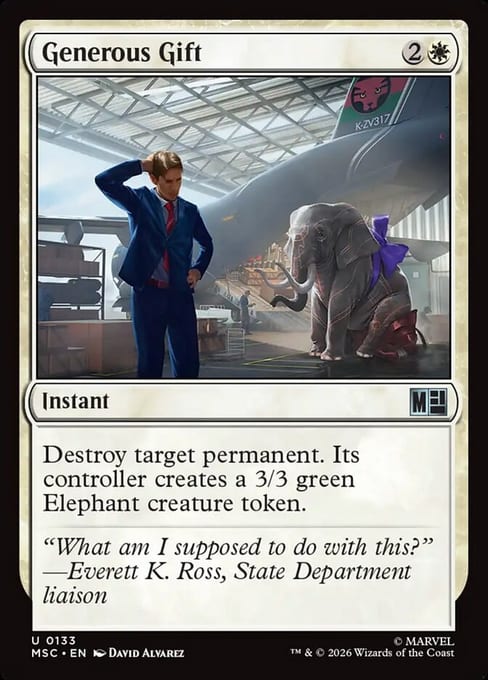
Another broad answer with the same token tradeoff.
The demonstrated ten-card pass does not cut the stock list’s efficient targeted answers. Its interaction exchange replaces a temporary monarch-based creature with an artifact creature that can compress opposing boards and also trigger T’Challa.
Step 5: make ten exact one-for-one swaps
Every cut below has one named replacement. That keeps the list auditable: ten cards leave, ten enter, and the total stays at 100. Values are for the exact printings linked in the ledger, not promises about a particular store’s inventory.
Swaps 1-2: make setup part of the artifact plan
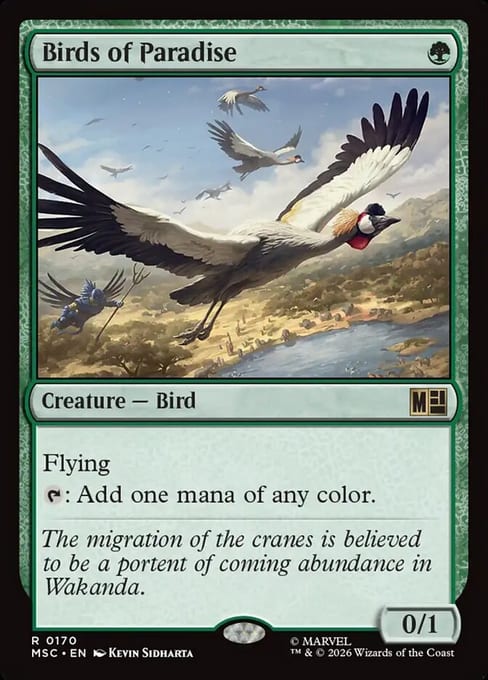
Out: Birds of Paradise (MSC 170). 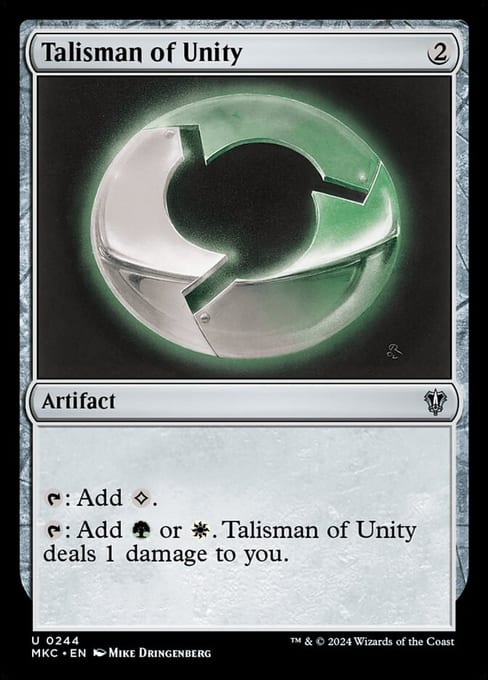
In: Talisman of Unity (MKC 244). 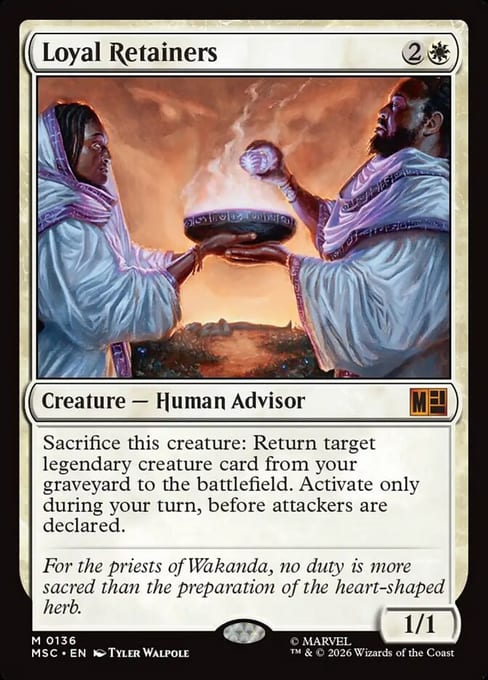
Out: Loyal Retainers (MSC 136). 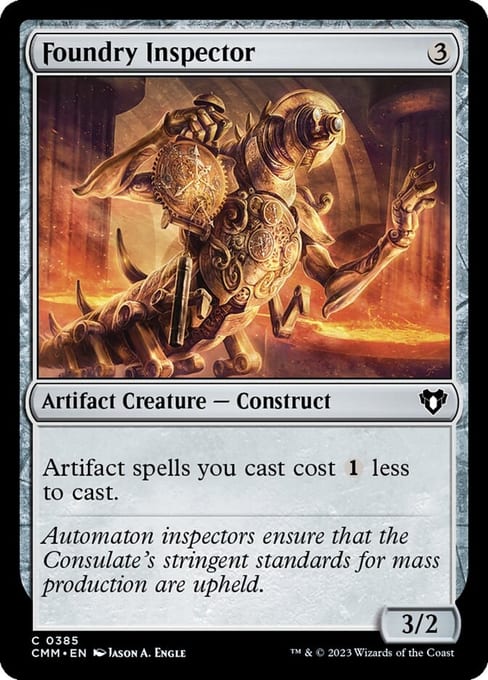
In: Foundry Inspector (CMM 385).
Swaps 3-4: move counters and draw earlier
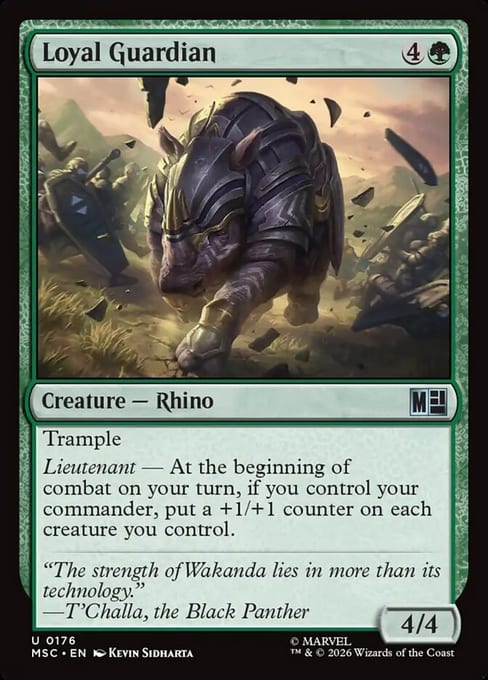
Out: Loyal Guardian (MSC 176). 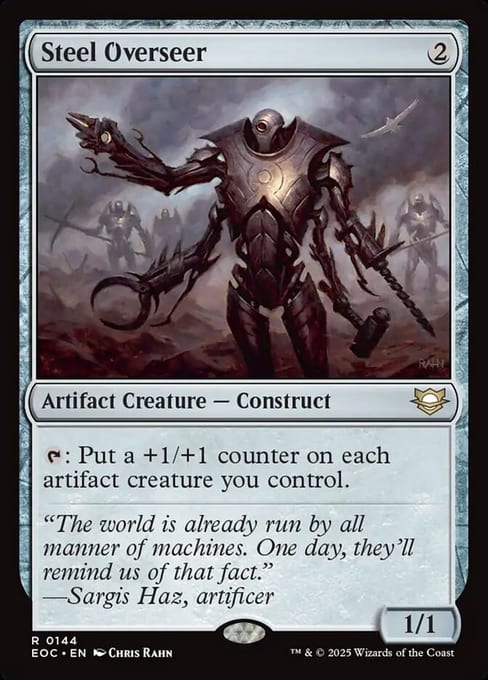
In: Steel Overseer (EOC 144). 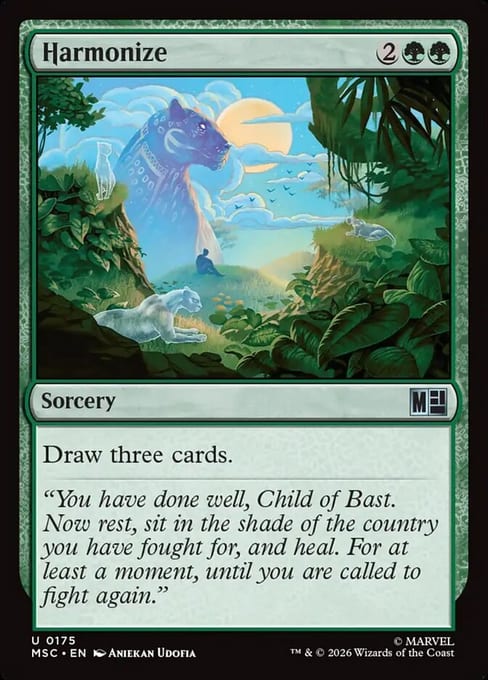
Out: Harmonize (MSC 175). 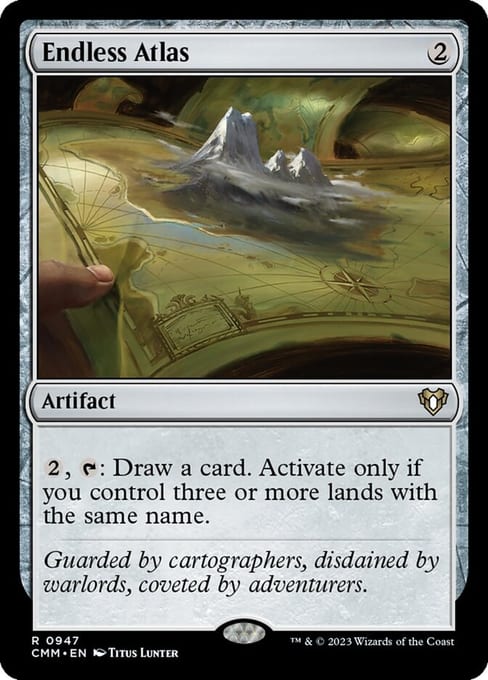
In: Endless Atlas (CMM 947).
Swaps 5-6: add artifact card flow and protection
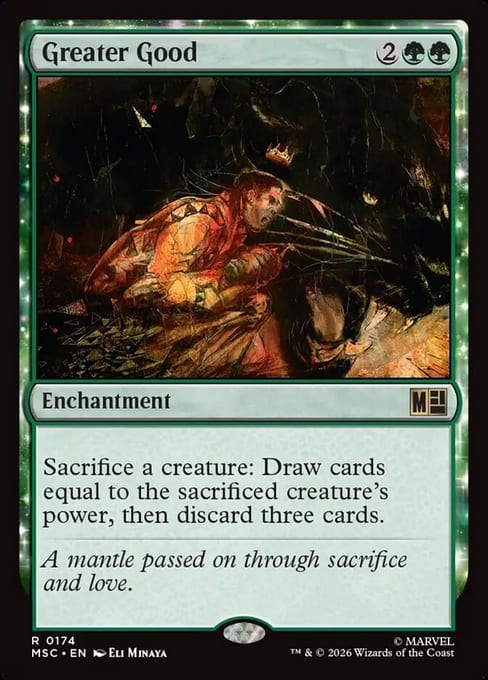
Out: Greater Good (MSC 174). 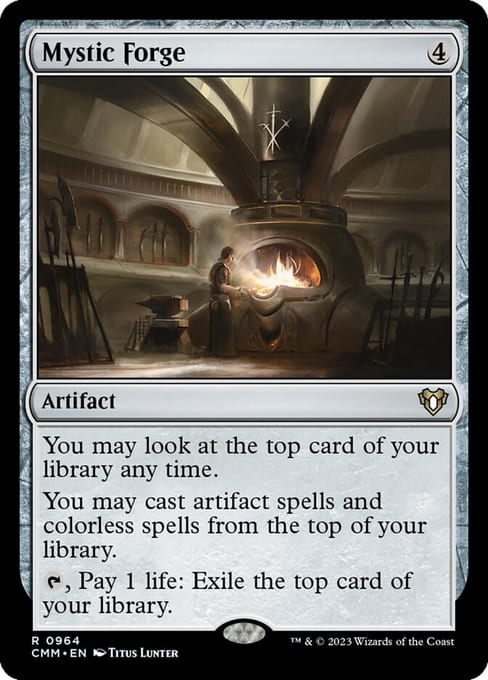
In: Mystic Forge (CMM 964). 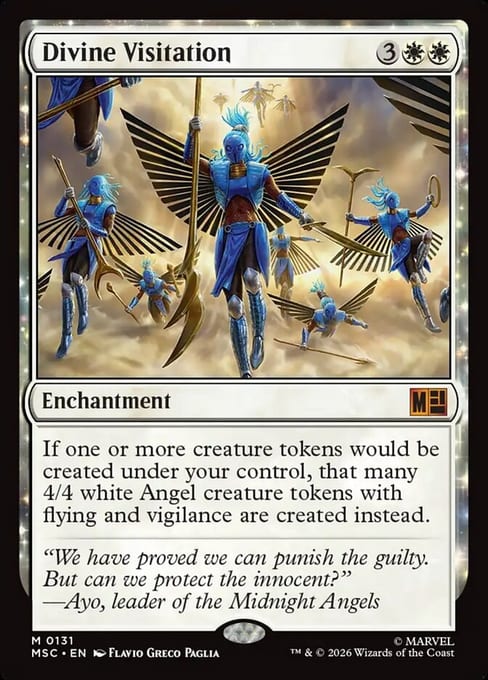
Out: Divine Visitation (MSC 131). 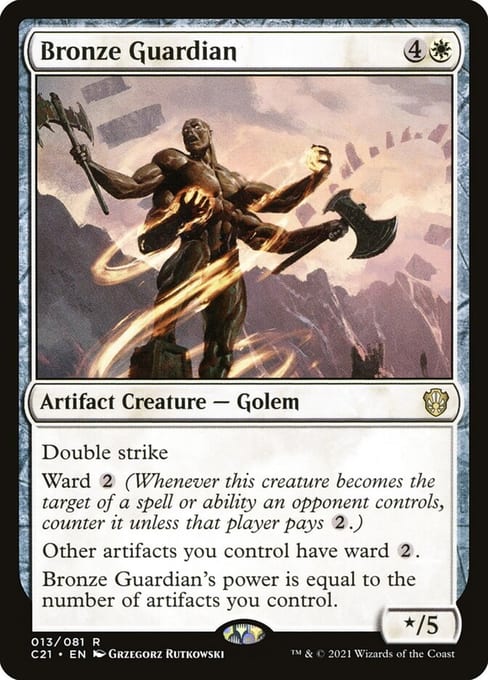
In: Bronze Guardian (C21 13).
Swaps 7-8: make interaction and resilience qualify
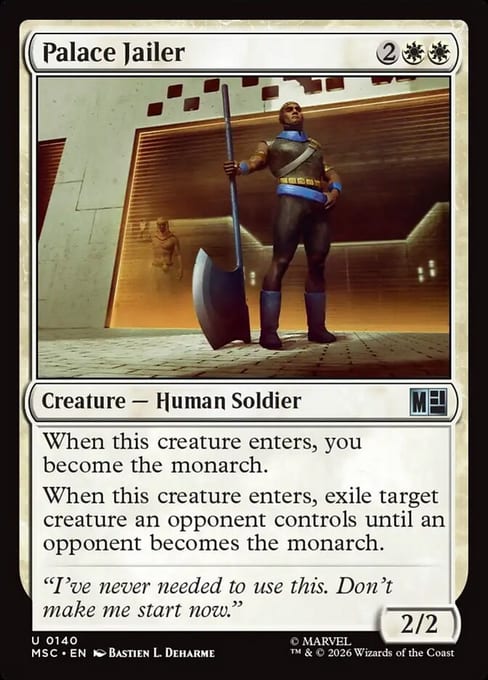
Out: Palace Jailer (MSC 140). 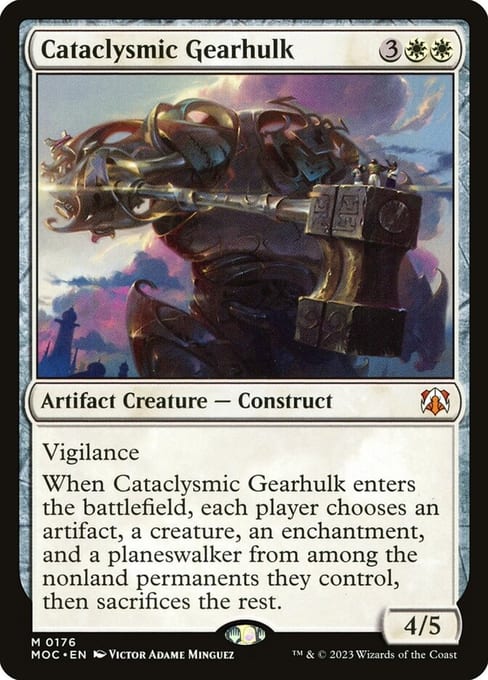
In: Cataclysmic Gearhulk (MOC 176). 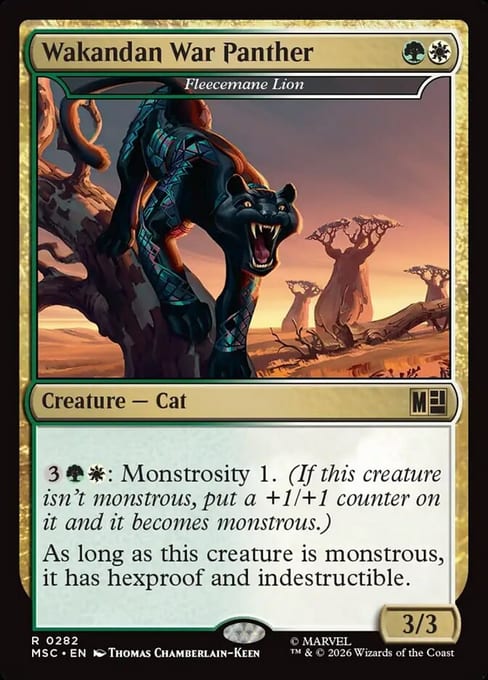
Out: Fleecemane Lion (MSC 282). 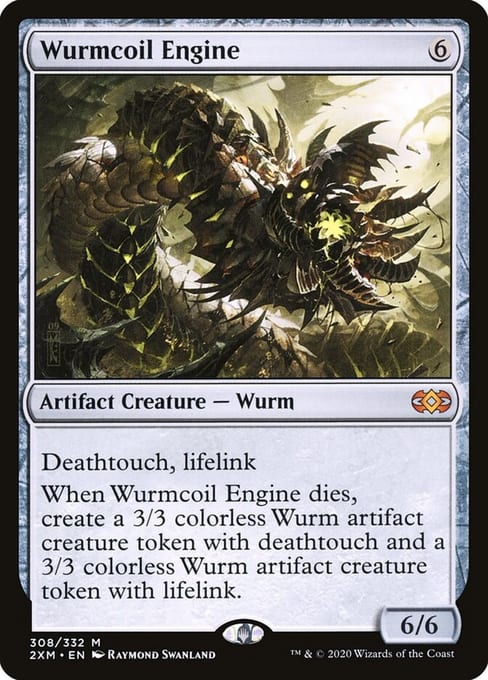
In: Wurmcoil Engine (2XM 308).
Swaps 9-10: connect draw to the tokens already produced
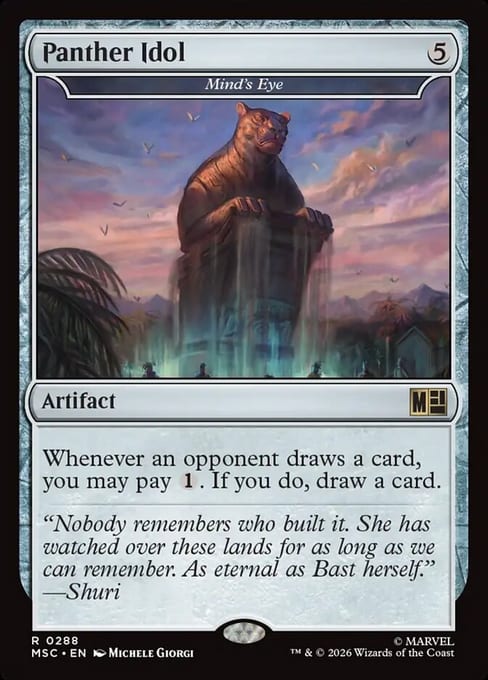
Out: Mind’s Eye (MSC 288). 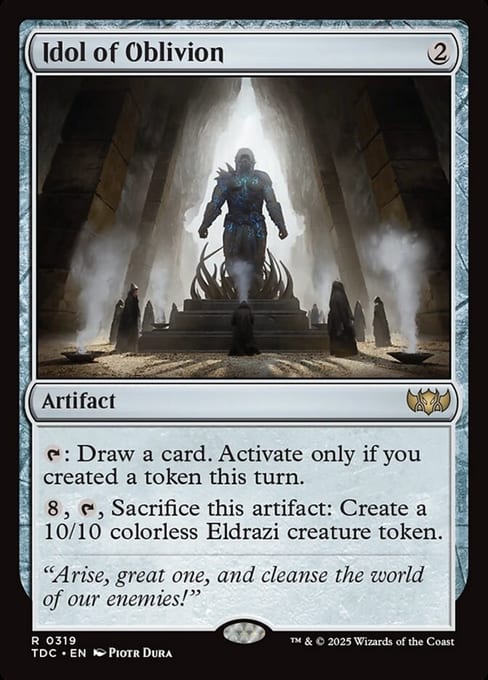
In: Idol of Oblivion (TDC 319). 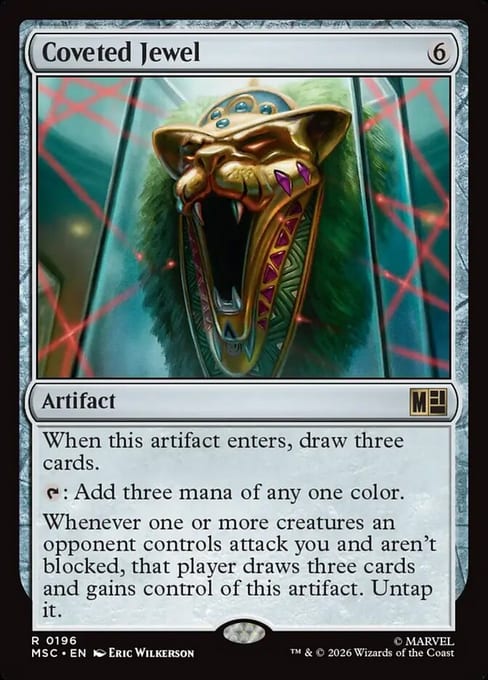
Out: Coveted Jewel (MSC 196). 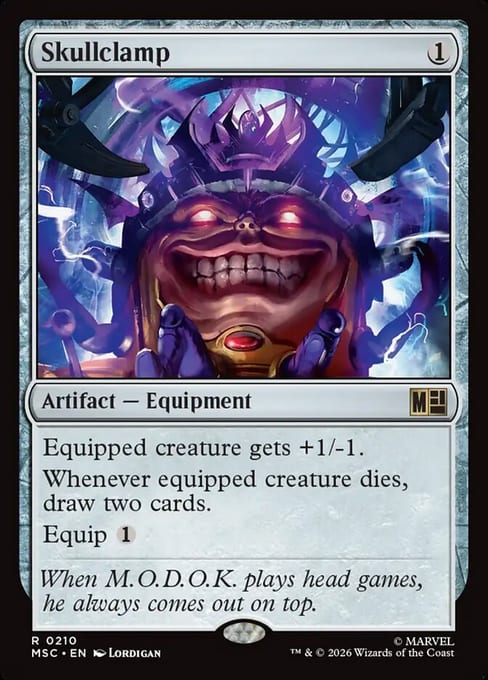
In: Skullclamp (MSC 210).
| # | Remove | Add | Why this exchange |
|---|---|---|---|
| 1 | Birds of Paradise, MSC 170 ($9.40) (opens in a new tab) | Talisman of Unity, MKC 244 ($3.04) (opens in a new tab) | Keeps a colored-mana slot while making the source an artifact and less vulnerable to creature-only sweepers. The tradeoff is moving acceleration from one mana to two. |
| 2 | Loyal Retainers, MSC 136 ($0.36) (opens in a new tab) | Foundry Inspector, CMM 385 ($0.42) (opens in a new tab) | Replaces narrow legendary-creature recursion with a reducer that affects every artifact spell. Record the discount as cost reduction, not mana production. |
| 3 | Loyal Guardian, MSC 176 ($0.32) (opens in a new tab) | Steel Overseer, EOC 144 ($0.37) (opens in a new tab) | Moves a counter effect from five mana to two and focuses it on artifact creatures, including Vehicles after they become creatures. |
| 4 | Harmonize, MSC 175 ($0.26) (opens in a new tab) | Endless Atlas, CMM 947 ($2.69) (opens in a new tab) | Exchanges three cards once for repeatable draw. With twelve Plains and twelve Forest in the stock list, the Atlas condition has real support, but it still requires three lands with the same name. |
| 5 | Greater Good, MSC 174 ($1.42) (opens in a new tab) | Mystic Forge, CMM 964 ($3.30) (opens in a new tab) | Removes a sacrifice-and-discard engine and adds top-of-library access for the upgraded list’s artifact and colorless spells. It also qualifies for T’Challa’s trigger. |
| 6 | Divine Visitation, MSC 131 ($0.43) (opens in a new tab) | Bronze Guardian, C21 13 ($1.23) (opens in a new tab) | Gives the artifact board ward 2 and supplies a double-strike threat whose power scales with artifact count. This consciously gives up Angel conversion for protection. |
| 7 | Palace Jailer, MSC 140 ($0.22) (opens in a new tab) | Cataclysmic Gearhulk, MOC 176 ($0.38) (opens in a new tab) | Replaces monarch-dependent temporary creature removal with a five-mana artifact creature that forces each player to keep only chosen permanent types. Sequence it carefully around your own board. |
| 8 | Fleecemane Lion, MSC 282 ($0.20) (opens in a new tab) | Wurmcoil Engine, 2XM 308 ($10.93) (opens in a new tab) | Trades a cheap standalone body for an artifact payoff with lifelink, deathtouch, and two artifact creature tokens when it dies. It costs much more mana and money, so it is the first optional omission if the pass feels too expensive. |
| 9 | Mind’s Eye, MSC 288 ($0.36) (opens in a new tab) | Idol of Oblivion, TDC 319 ($2.09) (opens in a new tab) | Moves a five-mana, pay-per-card engine to two mana. T’Challa’s enter or attack trigger satisfies the token condition on turns it resolves. |
| 10 | Coveted Jewel, MSC 196 ($0.28) (opens in a new tab) | Skullclamp, MSC 210 ($6.04) (opens in a new tab) | Replaces a six-mana burst that opponents can steal with a one-mana engine for the deck’s expendable 1/1 Soldier tokens. Do not attach it to a creature you need to keep at one toughness. |
The incoming package costs $30.49 at the recorded exact-printing values. The ten removed printings total $13.25, so the list’s current card-value estimate rises by $17.24 rather than by the full purchase total. Cards already owned still have opportunity cost; the two numbers answer different questions.
Step 6: compare the finished list with the original
Do the arithmetic before sleeving. None of these totals depends on intuition.
| Measure | Stock list | After ten swaps | Change |
|---|---|---|---|
| Total cards | 100 | 100 | 0 |
| Lands | 38 | 38 | 0 |
| Artifact spells | 28 | 36 | +8 |
| Artifact spells with mana value 4+ | 23 | 25 | +2 |
| Nonlands with mana value 1-3 | 26 | 29 | +3 |
| Nonlands with mana value 4-5 | 29 | 26 | -3 |
| Nonlands with mana value 6+ | 7 | 7 | 0 |
| Current card-value estimate | $69.05 | $86.29 | +$17.24 |
The value estimate totals the Scryfall USD field for each verified nonbasic printing and treats ordinary basic lands as $0. It is a comparison tool, not a sealed-product price or a guarantee that all ten cards can be bought together for that amount.
The structural consequence is clearer than “the deck is stronger.” The pass adds eight net artifact spells, adds two more artifact spells that trigger T’Challa, moves three nonland slots from the four-to-five band into the one-to-three band, and leaves the six-plus band unchanged. Every incoming card is colorless, green, or white in color identity, and none duplicates a card in the stock singleton list.
Step 7: test one claim at a time
Do not make another ten swaps immediately. Sleeve this version and collect evidence.
For each game, record:
- Whether the opening hand had two or three lands and an early mana play.
- The turn T’Challa first entered and first attacked.
- Whether Vibranium sat unused, and whether an artifact spell, equip cost, or activated ability could have spent it.
- How many mana-value-four-or-greater artifacts were cast while T’Challa was present.
- Which repeatable draw engine produced a card, and how many turns it survived.
- Whether a removed effect was actually missed.
- Which card was stranded in hand and why: mana, color, timing, or board state.
After five games, revise the diagnosis, not just the list. If six-mana cards still wait in hand, the next pass should lower the top end rather than add another finisher. If artifacts resolve but disappear before combat, add protection or recursion. If cards run out despite the four replacement engines, count actual cards gained and identify which condition failed.
Reusable precon-upgrade worksheet
Copy this into your deck notes before making the next change:
Commander plan:
Stock card count: 100
Land count:
Nonland mana-value bands (1-3 / 4-5 / 6+):
Reliable early mana sources:
Cost reducers, tracked separately:
Card-flow engines:
Single-target interaction:
Board resets:
Primary bottleneck:

CUT 1:                         ADD 1:
CUT 2:                         ADD 2:
CUT 3:                         ADD 3:
CUT 4:                         ADD 4:
CUT 5:                         ADD 5:
CUT 6:                         ADD 6:
CUT 7:                         ADD 7:
CUT 8:                         ADD 8:
CUT 9:                         ADD 9:
CUT 10:                        ADD 10:

Incoming purchase total:
Removed-card current value:
Net list-value change:
Cards after swaps: 100
Games tested:
Next observed bottleneck:
A precon upgrade is successful when its decisions can be explained and tested. Start with the commander, count the actual inventory, change one bottleneck with exact swaps, and measure what changed. The Wakanda Forever example is one defensible pass, not a mandatory shopping list; its method is the part to reuse.